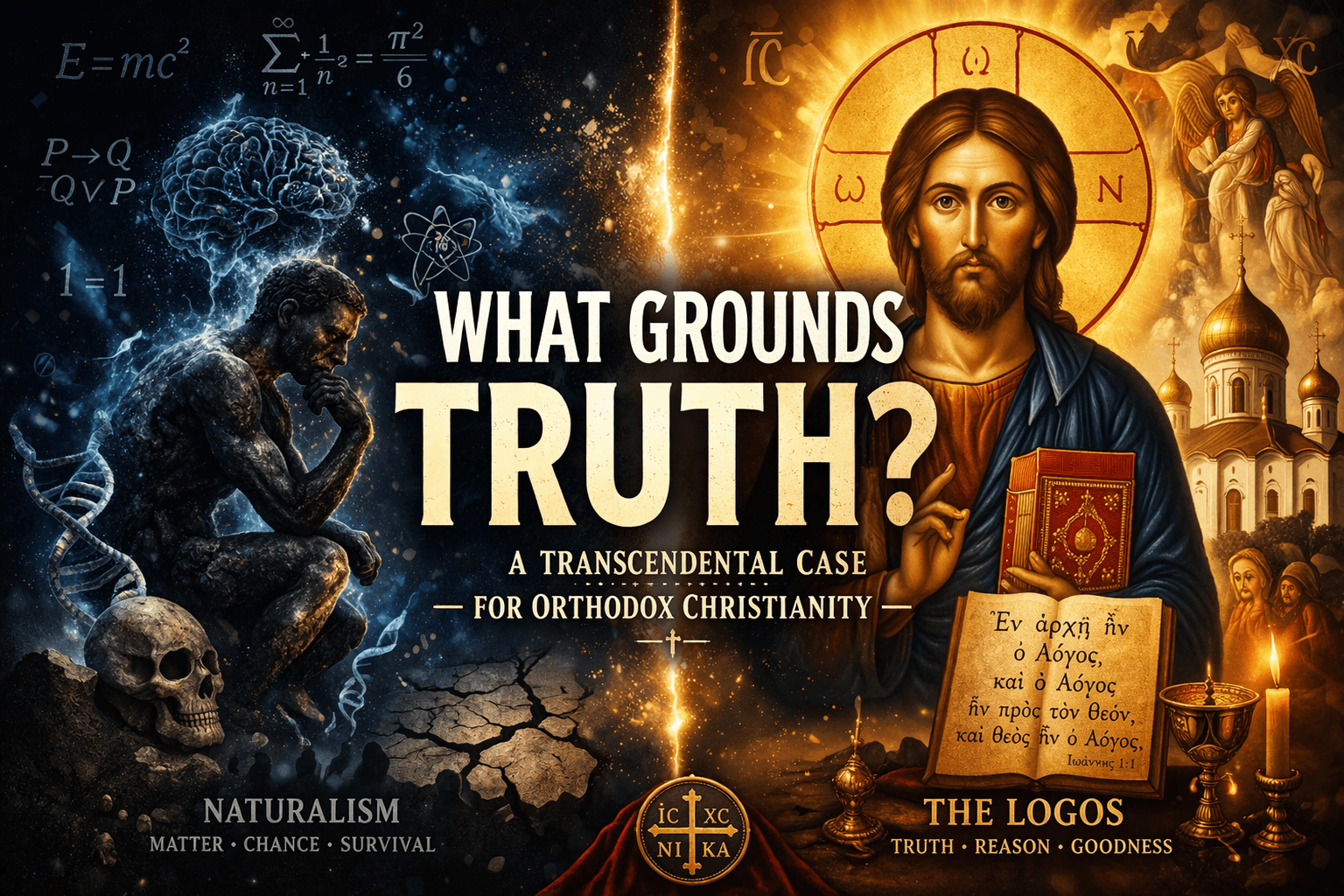
The Transcendental Argument
Let me start by clarifying; this article is first and foremost for myself and should not be treated as authoritative regarding orthodox theology. I am writing this simply to flesh out my thoughts and refine my wording when engaging with the transcendental argument.
I. Introduction - The Question Nobody Can Escape
Many atheists will readily concede that, without God, morality is subjective - a product of the individual, the culture, or evolution. And yet these same atheists will not extend that concession to truth itself. Two plus two is four, they'll insist - and of course they're right. But notice what that simple claim already presupposes: that there is a consistent reality outside the individual, that mathematical relationships hold universally across all people, all cultures, and all of time. That is an objective truth claim. This article is an exploration of what must be true about reality in order for that claim - or any claim - to be meaningful at all. The transcendental argument, at its core, says this: for anything to be knowable, there must exist concepts that are external to the physical world, unchanging, and universal. The question isn't whether such things exist because we all act as if they do. The question is what kind of universe could ground them and what worldview accounts for them.
II. The Effects of Naturalism
I'm going to do my best to build up a strong claim and genuine argument from the atheistic point of view so that I am not taking down a straw man. In summary, this is the is-ought problem for morality, and the objective Truth problem for logic and rationality.
Metaphysical naturalism - The atheist, at least the philosophically serious one, is typically committed to metaphysical naturalism: the view that the physical universe is all that exists. There is no supernatural realm, no immaterial soul, no divine mind behind the cosmos. What exists is what physics, chemistry, and biology can in principle describe. This is not an arbitrary assumption - naturalists argue it is the conclusion of centuries of scientific progress, in which supernatural explanations have been steadily replaced by natural ones. Bertrand Russell put it plainly:
Man is the product of causes which had no prevision of the end they were achieving, his origin, his growth, his hopes and fears, his loves and beliefs are but the outcome of accidental collocations of atoms.
This is a position held with intellectual honesty and, in its own way, a kind of courage. On this view, the universe is not meaningful in any deep sense - it simply is. Matter and energy operating according to physical laws, with no author, no telos, and no transcendent dimension. Everything that exists - including you, including your thoughts, including this article - is at bottom a physical process.
Epistemological consequences - If naturalism is true, the human mind is entirely a product of that material process. The brain is a biological organ, shaped not by a desire for truth but by evolutionary pressure for survival and reproduction. Cognitive faculties that helped our ancestors avoid predators and find food were selected for - not faculties that reliably track abstract, objective reality. This is where the naturalist faces one of his most serious internal tensions, one that Thomas Nagel - himself an atheist - pressed honestly in Mind and Cosmos: the standard Darwinian account of our cognitive evolution gives us no particular reason to trust that our minds are calibrated toward truth rather than toward mere fitness. A belief can be fitness-enhancing and completely false. The naturalist will typically respond that the same faculties that let us build tools and navigate the physical world also ground our confidence in logic and mathematics - that evolution has, in effect, given us reliable enough minds. This is a serious response and deserves to be engaged seriously, not dismissed. But notice the pressure point it leaves exposed: reliable enough is doing some heavy lifting there. Reliable enough to survive is a very different standard than reliably tracks objective, universal, abstract truth. The naturalist owes us an account of why a brain built by blind processes for survival should be trusted when it ventures into logic, mathematics, and metaphysics - domains that have no obvious survival value on their own.
The moral consequence - If the mind is a product of blind material processes, the moral sense is no different. What we call conscience - that visceral conviction that some things are wrong and not merely disliked - is, on the naturalist account, an evolved mechanism. Cooperation and empathy had survival value for social animals like us, and so natural selection built them in. Morality is the codified residue of that programming, reinforced by social contract and cultural consensus. The naturalist has two paths here. The first, and more honest, is Nietzsche's: without God there is no objective moral order, and the language of rights and human dignity is inherited furniture from a Christian civilization - furniture without a floor. The second is the path most contemporary atheists take: moral realism without God, grounding moral facts in human flourishing or rational consistency. This is the more livable position, but it faces a serious unpaid cost. Torturing children is wrong does not seem to be a statement about a physical state of affairs - it seems to be a binding claim on all rational agents everywhere. The naturalist must explain where that binding force comes from in a universe of matter and energy. Without a convincing answer, what looks like objective morality is ultimately descriptive - most of us prefer this - rather than genuinely prescriptive. And a morality that cannot say you are obligated is, as Nietzsche saw, merely the ghost of morality haunting a universe that can no longer account for it. If everything simply is, there is nothing we ought to do or believe.
III. The Transcendental Argument - Logic & Rationality
Consider the way we actually talk about logic. We don't say "that argument is illogical to me" - we say "that argument is illogical," full stop. The claim is universal, not personal. This is worth pausing on, because on a naturalist account it shouldn't be. If logic is simply a product of neurons firing, then my logic is my neurons and your logic is yours, and the most we could ever say is that our brains happen to agree. Yet nobody actually talks or thinks this way. When someone reasons badly we don't extend the same courtesy we'd extend to a difference in taste - we correct them. We hold them to a standard that exists outside of both of us.
The insanity case makes this vivid. We never grant that the schizophrenic's reality is equally valid simply because his brain is generating it just as genuinely as ours generates our own. We say he is wrong about reality - not differently opinioned, but wrong. If truth were simply whatever a brain produces, we'd have no basis for that judgment. But we make it instinctively and universally, which tells us something important: we all already believe, at the level of practice, that truth is something minds can fail to reach - which means it exists independently of any particular mind.
This same pressure applies to the naturalist's confidence in reason itself. If the human brain is a survival machine shaped by blind evolutionary processes, it was built to keep us alive, not to track abstract truth. A belief can be fitness-enhancing and completely false - the man who panics at every rustle in the grass survives longer than the one who stops to reason carefully about probability. Which means the naturalist who trusts his own reasoning is in an awkward position: the very faculty he is using to defend naturalism is, on his own account, a tool built for survival rather than truth. He is trusting a compass because it has pointed north before, while denying that north exists.
The moral dimension sharpens this further. If logic and rationality are ultimately in service of survival, then we should be willing to follow that logic wherever it leads. Consider - and I ask for your patience here, because the example is deliberately uncomfortable - the problem of a collapsing birth rate. If human survival is the governing logic, and birth rates fall below replacement, then on a pure survival calculus there would seem to be justification for using force to correct it. Forced conception. Considering this is a corrective action taken for survival, it should follow that it is both moral and logical from a naturalist view, since survival is what logic and morals exist in service of. So why are we repulsed by this idea? Where is that revulsion coming from? Not from evolution, which is indifferent to individual dignity. Not from social contract, which could in principle be rewritten. It is coming from somewhere that the naturalist framework has no room for - an objective moral reality that binds us whether we like it or not, and whether it helps us survive or not.
This is where The Logos comes in, which is too complex not to dedicate an entire section to.
The Logos - Logic Has a Name
The transcendental argument arrives at a striking conclusion: the laws of logic must be grounded in something abstract, universal, invariant - and personal. That last quality matters most. Logic is not a force like gravity, acting blindly on matter. It is rational, it is meaningful, it intends coherence. Whatever grounds it must be capable of intending something. It must, in other words, be a mind.
Orthodox Christianity does not scramble to meet this conclusion as science and philosophy discover more. It has been there from the beginning.
The Gospel of John opens not with a historical event but with a metaphysical declaration: In the beginning was the Logos. The word was not chosen casually. In the Greek-speaking world of the first century, Logos carried enormous philosophical weight - it named the rational principle underlying all of reality, the intelligible structure that makes the cosmos a cosmos rather than chaos. What John announces is that this principle is not an abstraction hovering above the world. It is a Person. And that Person entered history.
This is the Orthodox understanding of what reality fundamentally is - not a theological footnote but the load-bearing claim. Creation is not brute matter onto which rationality is somehow imposed from outside. It proceeds from the Logos, and so it is rational from within. The universe is intelligible because it is, at its root, an expression of divine reason. When a mathematician discovers that abstract equations describe physical reality with uncanny precision, when a scientist trusts that the cosmos will behave tomorrow as it did today, when a philosopher finds that the laws of logic hold across every culture and every century - they are, knowingly or not, trusting the consistency and Truth of the One from whom all things were made.
St. Justin Martyr gave this a name: the logos spermatikos - the seeds of the Word scattered throughout human reason and culture. Every person who has ever reasoned truly, Justin argued, has done so by genuine participation in the Logos, whether they acknowledged Him or not. The atheist philosopher who insists that a contradiction cannot be true and refuses to be argued out of it is, in that very insistence, bearing witness to the very thing he officially denies.
It is worth being precise here, because the Orthodox position differs sharply from a certain Western theological tendency that treats God's relationship to logic as a matter of divine legislation - God decreed the laws of logic, and so they hold. The problems with this view are real: it makes rationality contingent on a decision that could theoretically have gone otherwise, and it pictures God as a lawgiver standing above rationality rather than as its living source. Worse, it quietly distances God from creation, making the world's intelligibility a kind of issued permit rather than an ongoing presence.
But the temptation runs in the other direction too. If God did not decide that logic would be as it is, does that mean He was constrained by it - that some external rational order sat above Him, to which even He had to conform? This is the other horn of what turns out to be a false dilemma.
St. Gregory of Nazianzus confronted the same structure of confusion in a different but deeply related debate. His opponents pressed him: did the Father beget the Son voluntarily or involuntarily? The question was designed to trap. If voluntarily, the Son's existence seems contingent - God might have chosen otherwise, and the Son becomes a kind of divine project. If involuntarily, God appears subject to some necessity above Himself, compelled to generate what He did not freely choose. Either way, something seems to give.
Gregory's response was to refuse the dichotomy entirely. The question, he argued, smuggles in a category error. Will and nature are not in competition within God. The Father does not deliberate about whether to beget the Son, weighing options and selecting one. Nor is He dragged into generation by a force He cannot resist. The begetting of the Son is simply what God is - an expression of His eternal nature, which is neither chosen from outside nor imposed from outside, but is identical with who He is. To ask whether it was voluntary or involuntary is to import a human framework of deliberation-versus-compulsion into a divine reality that transcends both.
The same move dissolves the apparent puzzle about logic, morality, and the deep structure of reality. Did God choose that contradictions would be impossible, that goodness would be what it is, that two and two would make four? Or was He bound to these things by some necessity anterior to Himself? Neither. The rationality woven into creation is not a decree God issued, nor a constraint He inherited. It flows from what God eternally is - from the Logos who is not a principle God adopted or obeyed, but the second Person of the Trinity, expressing in creation the very character of divine being. The laws of logic hold not because God signed an edict, and not because He had no choice, but because creation proceeds from One whose nature is reason, truth, and coherence. To ask whether this was voluntary or necessary is to ask Gregory's question all over again - and to invite his answer.
IV. The Transcendental Argument - Morality
I don't find it entirely necessary to dive deep into the moral implications of naturalism. I would yield to one of two possibilities:
- Morals are outside the individual: To this I ask, where are they?
- Morals are subjective: To this I ask, is standing up to cruelty simply a matter of preference?
In the naturalist framework, morality has to be derived from one of the two - evolutionary programming or social consensus:
- Evolutionary programming: To this I ask, is survival then the framework by which we attribute morality and logic? And if so then I refer back to my forced conception question.
- Social consensus: Can be rewritten, think Nazi Germany.
Neither are binding, this again makes us face the is-ought problem. Dostoyevsky famously stated:
"If God does not exist, everything is permitted."
How exactly can one argue against this, what is the justification for moral revulsion besides simply personal preference? This extends beyond morals as well, two plus two being five is also permitted, because again we have no basis for trusting our logical or rational processes, in fact from a naturalist view we have good evidence that they are not trustworthy. Christianity offers a coherent explanation, humans as image-bearers (imago Dei) which grounds human dignity and moral obligation.
Orthodox Christianity does not locate morality in a rulebook imposed by a distant ruler, nor in the emotional architecture evolution happened to produce, nor in the shifting consensus of whoever currently holds power. It locates morality in what a human being is.
Genesis declares that man is made in the image and likeness of God - the imago Dei. This is a metaphysical claim about human nature: that every person bears within them a real participation in divine reason, dignity, and personhood. This is why cruelty is not merely unpleasant. It is a desecration. The moral weight is not projected onto persons by social agreement - it is intrinsic, immutable, and not subject to renegotiation by any majority or regime.
This is precisely what Nazi Germany and the Bolshevik Soviets could not accommodate. The moment human dignity becomes a social construction, it can be socially deconstructed. If morality is consensus, Nuremberg was not a crime - it was simply the less favored position.
The imago Dei breaks this logic. It says there is something about a human person that no government can grant, because no government created it, and therefore none can revoke it. The obligation to refuse cruelty is not a preference. It is a recognition - the proper response to what is actually there.
Here is the answer to Dostoyevsky's challenge. "If God does not exist, everything is permitted" is not rhetoric - it is precise. Without a transcendent grounding for human nature, the category of forbidden has no content. But if the human person genuinely bears the image of God, then some things are not merely discouraged. They are wrong, in the same way two and two making five is wrong: not because someone decided so, but because reality does not bend to accommodate the claim.
V. Can Naturalism Answer Back?
"Logic is just how our minds work" - Conventions are revisable by definition. No culture has ever successfully revised the law of non-contradiction, nor can one even coherently attempt to. That's not a convention - that's something that constrains thought rather than being produced by it.
"Evolution gave us reliable enough cognition" - Plantinga's objection stands: evolution selects for behavior, not belief. The same adaptive behavior can be produced by countless false belief-sets. "Reliable enough to survive" is simply not the same standard as "reliably tracks abstract truth," and using your faculties to validate those same faculties is circular in a way the naturalist cannot escape.
"We can have morality without God" - Secular moral realism is borrowed capital. The intuitions it relies on - human dignity, binding obligation, the wrongness of cruelty - were not generated by secular philosophy. They were inherited from a civilization that believed man bore the image of God.
"Your God is just another assumption" - Every worldview has ultimate commitments it cannot prove from something more basic. The question is never whether you have a starting point - everyone does. The question is which starting point is self-consistent and can actually account for the things we all already know: that logic holds, that truth is real, that cruelty is wrong. Your worldview must stand up to internal critique.
VI. The Orthodox Dimension - More Than an Argument
The transcendental argument, as an argument, can be won on a Tuesday afternoon and change nothing. That would be a tragedy, because the point is not the argument - the point is what the argument is pointing at.
Orthodoxy has never treated the Logos as a philosophical abstraction that happens to map onto Christ. John's prologue is not apologetics retrofitted onto a religious tradition. It is the foundational confession of the faith - that the rational principle the argument arrives at is not an impersonal structure hovering above reality, but the second Person of the Trinity, who is not merely the ground of reason but is Himself the Living God. St. Justin Martyr saw clearly that every human being who has ever reasoned truly has done so by genuine participation in this Logos - that the philosopher who refuses contradiction and the scientist who trusts the consistency of nature are, knowingly or not, standing on ground they did not build.
Christ says I am the Truth - not "I teach the truth" or "I point toward truth." This is not a poetic claim. It is a metaphysical one, and it is precisely what the transcendental argument demands: that truth be grounded not in an abstraction, but in a personal, rational, eternal mind. Orthodox theology does not arrive at this conclusion reluctantly or by accommodation. It has always been the starting point.
VII. Where the Argument Leaves You
The transcendental argument does not force belief, nor does it pretend to. What it does is remove a certain kind of intellectual shelter - the idea that one can consistently affirm objective truth, binding logic, and real moral obligation while grounding reality in nothing but blind, impersonal processes.
That position is not foolish. It is familiar. It is livable. But it cannot finally account for the very things it depends on, and this is the heart of the issue. Every debate and disagreement rely on one fundamental thing, that there is indeed a right and wrong. What this argument does is claims that whatever presuppositions you have about the world, they must be consistent, and naturalism simply misses the mark and cannot pass an internal critique.