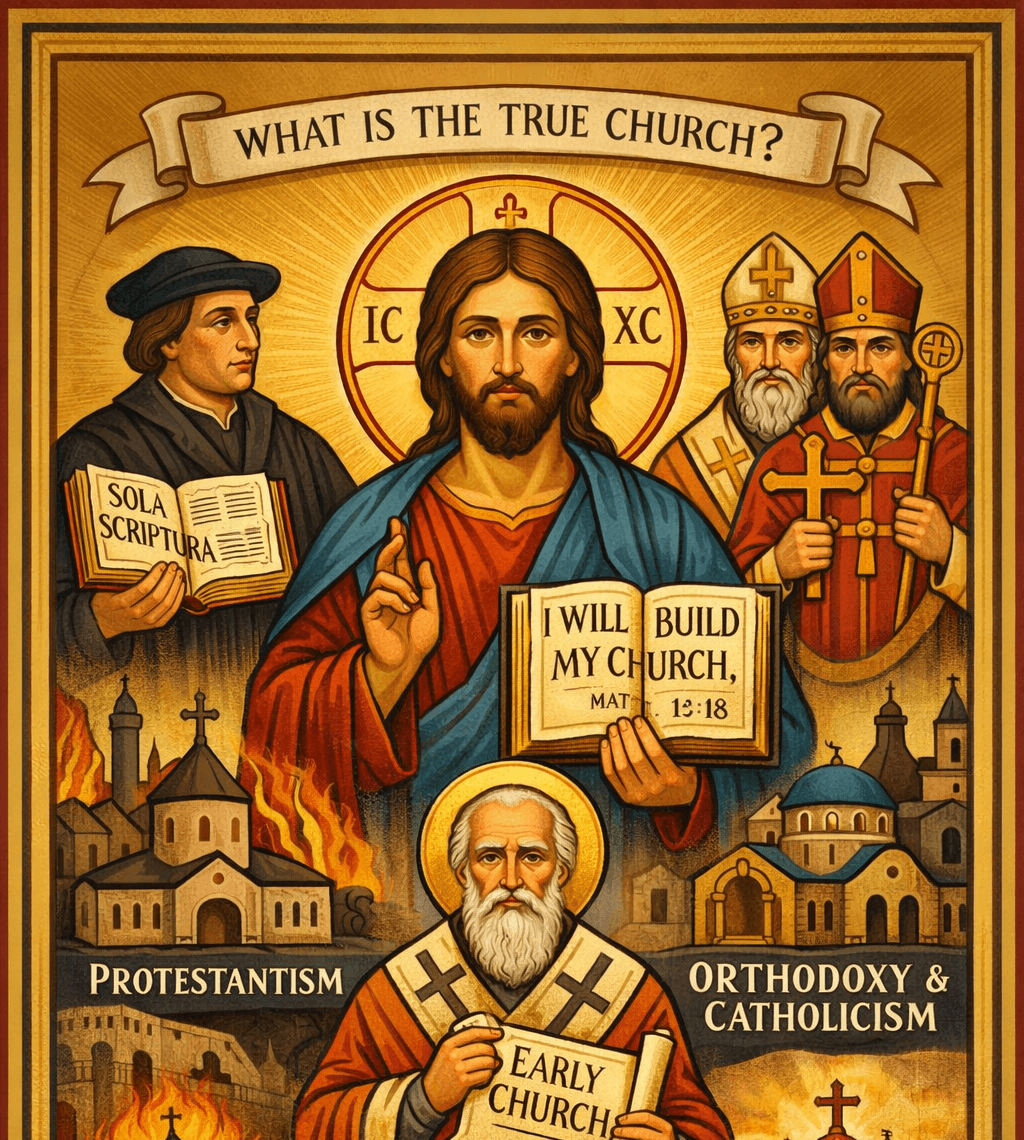
If the Early Church Was Right, What Does That Mean for Protestants?
This article is an attempt to think carefully and honestly about a question many Christians sense but rarely articulate: what exactly is the Church, and how do we know?
For much of modern Protestantism, that question is treated as settled-or at least unimportant compared to personal faith, Scripture, and moral conviction. Yet history, theology, and lived Christian experience complicate that assumption. When questions of authority, continuity, sacraments, and unity are taken seriously, the neat boundaries many of us inherited begin to blur.
What follows is not an argument against Protestantism, nor a declaration of conversion. It is a structured examination of why Orthodoxy and Catholicism increasingly present themselves as serious answers to questions Protestantism struggles to resolve-especially once the early Church is allowed to speak for itself.
I. Why This Question Even Matters
I have been a Christian for my entire life. I went to Sunday school and bible study growing up, got involved in FCS (fellowship of Christian students) during high school, and even took on a leadership role in a Christian organization during college. For the past year of my life, I have become deeply interested in church history, modern miracles, and contemporary Christian political thought. This has led me down a rabbit hole I never expected to find myself in and I now question some things I have believed since a child.
Summing up the entire tension of the discussion is this question:
If the apostles were alive today, where would they worship?
II. What Protestantism Gave Me (And Why I’m Grateful)
Growing up as a Protestant, I inherited a deep love for the Bible. Amid all the uncertainties of life, there has always been one anchor I was taught never to doubt: the truthfulness of Scripture. The Bible is not merely inspired, but God-breathed-the words of the Almighty, written by many hands yet speaking with a single divine author. Disagreement on secondary matters was acceptable, so long as all were willing to submit to the authority of Scripture itself.
Alongside this came a serious moral formation. Not a vague call to “be a good person,” but an understanding of morality as something real, objective, and eternal. Love for Christ was not presented as an accessory to life, but as its center, and it remains the most important thing to me.
I was also taught something equally essential: the fallibility of human beings. We are fallen, limited, and incapable of perfection. This applies not only to friends and family, but to rulers, institutions, and even spiritual leaders. This recognition lies at the heart of the Protestant argument-and for good reason. Yet it is also where some of the deepest problems begin.
I am profoundly grateful for these foundations. But gratitude does not require immunity from examination. That these convictions came to me through Protestant Christianity does not mean they should remain unquestioned-or that the framework which delivered them is beyond critique.
III. The Problem of Authority
The central doctrinal claim of Protestantism is sola scriptura: Scripture alone is the authority in matters of theology. Human interpretations, traditions, and institutions are regarded as fallible, while the Bible itself stands as the only infallible standard. Because of this, every claim-no matter its source-must be tested by the individual against Scripture.
In principle, this approach is intellectually serious and morally cautious. In practice, however, it introduces a significant tension. The Bible is not a simple text to interpret. Its difficulty lies not merely in its length, but in its language, historical context, literary form, and theological density. Most modern readers do not speak biblical Hebrew, Aramaic, or Greek. As a result, the moment one opens an English Bible, one has already entrusted a meaningful degree of interpretation to translators-who must decide which words, phrases, and structures best convey the original meaning.
Translation is not neutral. Every choice reflects an interpretive judgment. Over time, these judgments have shaped theology, sometimes subtly, sometimes decisively. In certain cases, entire doctrinal debates hinge on how a single word or phrase is rendered.
Let me give a few examples:
Baptism - Acts 2:38
“Repent and be baptized every one of you for the forgiveness of your sins…”
The Greek word eis is often translated as “for,” but some Protestant-friendly translations and interpretations soften this to mean “because of” or “as a result of.” If eis means “for the purpose of,” baptism is directly connected to forgiveness. If it means “because of,” baptism becomes a symbolic response to forgiveness already received. The theology changes entirely, yet the reader rarely knows a linguistic decision has been made on their behalf.
Eucharist - John 6:53–56
“Unless you eat the flesh of the Son of Man and drink his blood, you have no life in you.”
In John 6, Jesus does not soften this language when his audience reacts with confusion and offense. Instead, the Greek shifts from the general verb for eating (phagein) to a more graphic term (trōgein), meaning “to chew” or “to gnaw.” Many English translations preserve the surface wording while theological footnotes or teaching traditions preemptively frame the passage as metaphorical-equating eating with believing. Others allow the language to stand on its own, suggesting a more literal participation. Whether the Eucharist is understood as symbolic remembrance or real communion often depends less on the words themselves and more on how the reader has been taught to interpret them before encountering the text.
Justification - Romans 3:28
“For we hold that one is justified by faith apart from works of the law.”
The phrase “works of the law” (ergōn nomou) can be read narrowly-referring to Jewish ceremonial observances-or broadly, as all human works whatsoever. Protestant theology typically assumes the broader meaning, while Catholic and Orthodox readings emphasize the former. The English phrasing appears straightforward, but the theological conclusion depends on assumptions about what Paul meant by “law”-assumptions the text itself does not explicitly define.
These tensions eventually pushed me beyond the text itself and toward the world in which the text was first received. If Christians have always read Scripture through some inherited understanding, then the most responsible place to look is not the present, but the past. Church history ceased to be background information and became central to the question I was asking.
IV. A Sucker Punch From History
In search of answers, I began reading the writings of early Church fathers and saints such as Ignatius of Antioch and John Chrysostom. What I encountered there led me to a conclusion I was not sure I was prepared for.
The Christianity believed and practiced by the apostles-and by those who knew Christ personally or learned directly from His immediate successors-looked remarkably different from the Christianity I had inherited and practiced. This was not a matter of minor emphasis or cultural expression, but of structure, theology, worship, and authority.
As I continued reading, I was struck by how unfamiliar much of Christian history was to me. I had gone my entire life without ever seriously encountering accounts of miracles that Christians have regarded as real and observable throughout the centuries: the Holy Fire in Jerusalem on the eve of Pascha, reports of levitating saints, Eucharistic miracles, the stigmata, miracles associated with the ecumenical councils, and even icons said to emit oil continuously without explanation. What surprised me most was that I had never even heard of these things growing up, even though some of them have been proven beyond doubt to be real, even by atheists. They were largely absent from my Protestant formation-not engaged, not refuted, but simply ignored. In fact, my interest in these accounts preceded my deeper exploration of Catholicism and Orthodoxy, and they became one of the sparks that set this journey in motion.
Alongside this, my historical reading made another fact increasingly difficult to avoid; for nearly all of Christian history, the Church understood itself as a visible, organized body. Participation in the faith was inherently communal-public, sacramental, and accountable-rather than primarily private or individual. Christianity was something believers entered into together, not something practiced in isolation. This is why excommunication and exile were such big deals, if faith was simply something private and secretive, why would it matter if an individual was barred from church?
V. Apostolic Continuity vs. Restarting the Church
Within Protestant Christianity, doctrinal disagreement often results in institutional separation. When a new interpretation gains traction, a new denomination frequently follows-effectively forming a new church with its own theological emphases and boundaries. This has produced a landscape in which believers can move between Protestant churches and encounter radically different teachings, each claiming fidelity to Scripture while emphasizing entirely different aspects of it.
This fragmentation was not the original intent of the Reformation. The Reformers did not understand themselves to be founding a new Church, but to be reforming the existing one-calling Christianity back to its original purity. Yet I struggle to accept this claim, even apart from the modern splintering that followed. For the idea of a “return” to authentic Christianity to make sense, one must first assume that authentic Christianity disappeared at some point in history.
That assumption also appears incompatible with Christ’s own description of the Church. He did not promise to establish a community that would collapse, vanish, or lose its identity for centuries before being rediscovered. He also did not claim that His Church would be created by anyone other than himself. Instead, He declared:
“I will build my church, and the gates of hell shall not prevail against it” Matthew 16:18
This is not the language of a provisional or temporary institution. Christ does not speak of a Church that would fail, disappear, or require re-creation or reformation at a later date. If His words are taken seriously, then the Church must have remained present, visible, and continuous throughout history.
VI. Sacraments, Not Just Symbols
A major divide between the pre-Reformation Churches and modern Protestantism lies in their understanding of the sacraments-an area where Protestant traditions themselves differ widely. In my own experience, communion was infrequent, observed only a handful of times each year. When it was administered, the bread was explicitly described as representing the body of Christ, and the wine or juice as representing His blood. Participation was broadly open: baptized or not, committed Christian or curious visitor, all were welcome to partake.
Baptism was treated in a similarly minimalist way. Across every Protestant church I attended, baptism was framed as an optional outward expression of an inward faith-a symbolic act of “going public.” The implicit assumption was that faith is formed privately and internally, and only later displayed externally through baptism. In this framework, baptism does not do anything; it merely signifies something that has already occurred.
Both the Catholic Church and the Eastern Orthodox Church reject this understanding outright. More strikingly, they do so not on the basis of later tradition alone, but through sustained appeal to Scripture itself-an irony, given how strongly Protestants emphasize biblical authority.
The Eucharist: Catholic and Orthodox Defense
Catholic and Orthodox theology holds that the Eucharist is not a symbol, but a true participation in the body and blood of Christ. This position rests first on Christ’s own words, but it is reinforced decisively by how those words were understood by the earliest Christians.
At the Last Supper, Jesus does not say, “This represents my body,” but “This is my body” (Matthew 26:26). Likewise, in John 6, Christ repeatedly insists that His followers must eat His flesh and drink His blood in order to have life. When many of His disciples recoil at this teaching and walk away, He does not correct them, soften His language, or explain that He is speaking metaphorically. Instead, the Greek intensifies-from a general term for eating to language meaning “to chew” or “to gnaw.” This is especially striking when contrasted with John 4, where Jesus does clarify His meaning once confusion arises. In the case of the Eucharist, no such clarification is offered.
This literal understanding is not a later medieval development; it appears immediately in the writings of the early Church. Writing around A.D. 107, Ignatius of Antioch-bishop, martyr, and a disciple of the apostle John-describes heretics as those “who abstain from the Eucharist and from prayer, because they do not confess that the Eucharist is the flesh of our Savior Jesus Christ.” For Ignatius, denial of the real presence was not a secondary disagreement, but a defining mark of false teaching.
Paul reinforces this realism in 1 Corinthians 11, warning that those who receive the Eucharist unworthily are “guilty of the body and blood of the Lord” and may even bring judgment upon themselves. Such language makes little sense if the elements are purely symbolic. One cannot be guilty of mishandling a metaphor. Paul’s warning presupposes that something objectively holy is being received.
Later Church Fathers echo this same understanding. Justin Martyr writes in the second century that the Eucharist is not ordinary bread or drink, but the flesh and blood of the incarnate Jesus. Irenaeus of Lyons argues that the Eucharist proves the goodness of the physical world, since Christ offers His real body as food. Across geography, language, and time, the testimony is consistent.
This historical continuity also explains why communion was universally restricted to baptized believers in good standing with the Church. If the Eucharist truly is what Christ says it is-and what the earliest Christians believed it to be-then it cannot be treated as a casual act of remembrance or an open ritual detached from discipline and preparation. It is not merely symbolic worship, but sacramental participation.
Baptism: Catholic and Orthodox Defense
Similarly, Catholics and Orthodox understand baptism not as a symbolic testimony but as an act that accomplishes something real. Scripture consistently speaks of baptism as salvific and transformative.
Peter declares, “Repent and be baptized… for the forgiveness of your sins” (Acts 2:38). Paul describes baptism as participation in Christ’s death and resurrection (Romans 6:3–4), and as the means by which one is clothed with Christ (Galatians 3:27). Most strikingly, Peter states plainly, “Baptism now saves you” (1 Peter 3:21), carefully clarifying that its power is not mere external washing but God’s action through it.
From this perspective, baptism is not the public display of a privately secured faith, but the means by which one is incorporated into the Church and into Christ Himself. Faith is not something perfected in isolation and later expressed; it is something entered into sacramentally, within a visible community, through God’s initiative rather than human declaration.
VII. Unity That Survives Disagreement
Christianity has never been without disagreement. The difference between traditions lies not in whether conflict exists, but rather how that conflict is settled.
In modern Protestantism, unity often depends on agreement. When serious doctrinal disputes arise, separation is commonly seen as the responsible solution. New denominations or movements form, each claiming appeal to Scripture, and disagreement is effectively resolved by division. Over time, truth is implicitly tested by who gathers followers rather than by any shared authority, and which one gathers more followers could boil down to which one leads to a more 'pleasurable' lifestyle, as the inquirer sees both as authoritative figures. Many protestants could very well be choosing churches based on which one allows them to most comfortably remain in whichever lifestyle they choose, while simultaneously appealing to scripture to show that they are indeed the 'true Christian'.
The early Church responded very differently. When major disputes emerged, believers did not separate but rather gathered together. Bishops met in councils, debated openly, appealed to Scripture and apostolic teaching, and sought clarity together. These councils were understood as spiritual events, undertaken with prayer and fasting, trusting that the Holy Spirit actively guided the Church into truth. Records of these councils often include miraculous events that marked the confirmation of sound doctrine within the councils by the Holy Spirit.
Doctrine was not negotiated nor capitulated but discerned. Once defined, it was binding, allowing unity that surpasses disagreement. This model assumes a visible Church capable of resolving conflict without fragmenting.
That vision remains compelling: a Church confident enough to confront error, argue intensely, and still remain one. The question it raises is simple but unsettling-if this was how the Church once handled disagreement, why is division now treated as normal?
VIII. What I Still Struggle With
Despite all these issues on which I see the blatant flaw of Protestantism, there are still struggles I find when faced with Catholicism and Orthodoxy, though admittedly many of them are with Catholicism alone.
The first of which is Papal authority, before the schism, there was no 'Pope' as we understand it today, rather there were many popes as the heads of the one unified church. With the history of Papal abuses and seemingly immoral actions and statements coming from the Pope throughout history, who is meant to be the head of the Catholic church, and by their view the leader of all Christians, surely the Holy Spirit would not allow such deception and corruption to infiltrate the church (as mentioned earlier in Matthew 16:18).
Another question I would have is for Catholics; if you claim to be the single unchanging church founded by Christ, why was the recitation of the Nicaean Creed changed during the schism in Catholic practice (Addition of the Filioque)? Orthodoxy retained the original.
Finally, there is a more personal struggle-one that cuts across both Catholicism and Orthodoxy. Conversion would inevitably force me to reconsider the spiritual status of friends and family who remain Protestant. Even if these traditions allow room for mystery and mercy, the shift in ecclesiology alone would place a weight on my conscience that I do not take lightly. I worry that this could lead to an unhealthy zeal or a subtle spiritual pride-a posture of being “more enlightened” rather than more loving. I fear that in my zeal for sharing the newfound truth that I may come off as arrogant, moralizing, and push them further away.
These questions do not negate the force of the arguments drawing me toward historic Christianity, but they do prevent easy resolution. If the Church Christ founded is indeed one, holy, catholic, and apostolic, then entering it should demand careful thought-not only about doctrine, but about responsibility, authority, and love.
IX. Where This Leaves Me Now
I am increasingly willing to let history correct me. The further I look into the life of the early Church, the harder it becomes to treat the past as irrelevant or optional. If Christianity claims continuity with the apostles, then the beliefs and practices of those closest to them deserve significant attention. That willingness to be corrected has required me to admit something uncomfortable: Protestantism, despite its strengths, may not represent the final or complete expression of the Christian faith.
For the time being, I remain Protestant. What has changed is not my faith in Christ, but my posture toward traditions I once dismissed and even mocked. Catholicism and Orthodoxy no longer appear to me as foreign attempts at worshipping my God but as serious claims to continuity that demand careful consideration.
If Christianity is true, it should be able to withstand scrutiny. If Orthodoxy or Catholicism are true, they should not fear investigation. And if Protestantism is true, it should not fear comparison. Faith that cannot be examined is not strengthened by its protection-it is weakened by it.