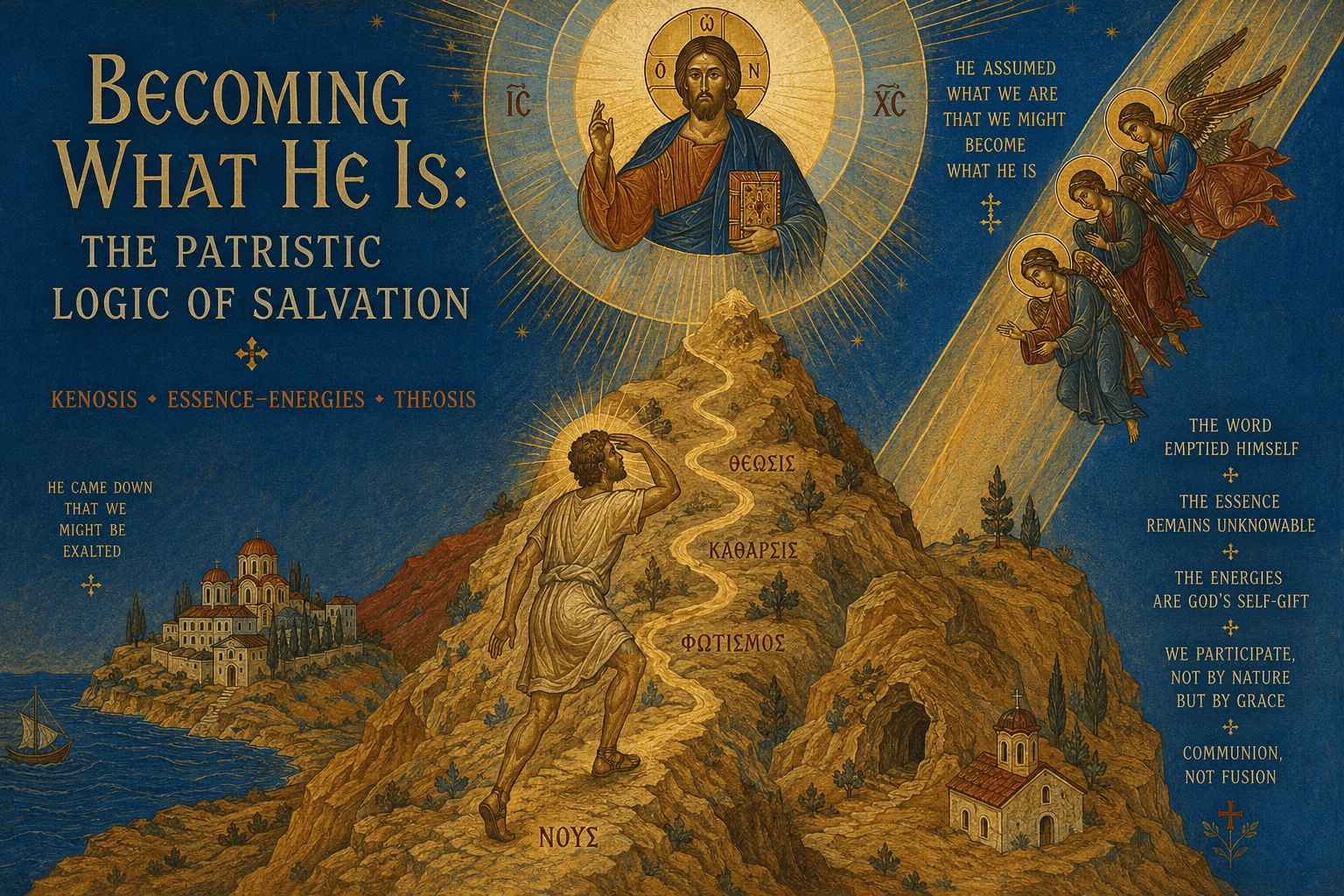
Kenosis, Essence–Energies, Theosis
I. Picking Up the Thread
A. Where the last piece left off
An earlier article worked through the patristic doctrine of the nous and the image of God in man, and ended at a cliff.
The argument, briefly: man is not made in the divine likeness as a finished product. He is made with a faculty (the contemplative summit of the soul, what the fathers called the nous) that is designed for God the way the eye is designed for light. The image is what makes a human a human and not a clever animal. But the likeness is something else. It is what the image is for. Man is created with the image and called toward the likeness, and the gap between the two is the whole drama of the spiritual life.
That distinction — image given, likeness acquired — is not at all common in the West. But it is everywhere in Irenaeus, in Athanasius, in the Cappadocians, in Maximus., and it ended the previous article with a question I could not answer there.
If the likeness must be acquired, and if "likeness to God" means likeness to the uncreated Creator of all that exists -- then how? By what mechanism? A creature cannot manufacture likeness to its Creator out of its own materials. A finite thing cannot generate the infinite from inside itself. The image gives man the receptive organ, but the weight-bearing word here is receptive. So where does the content come from? How does a creature become like the Uncreated without ceasing to be a creature, and without the Uncreated ceasing to be Uncreated?
The previous article posed the question but did not give a very precise answer, this is the goal of the following piece.
B. The strangest claim in Christian theology
The answer the fathers gave is the strangest claim in the whole of Christian theology, and it is the one that modern Western Christianity has done the most to dilute.
The Word who is the eternal image of the Father — the one in whose image we were made — descended into the image of that Image. Into our nature. Into our nous. Into our actual human life, with its hunger and its sleep and its sweat and its death. He did this not to give us a moral example, nor to settle a legal debt in the abstract, nor to be some archetype of moral struggle. He did it to accomplish from inside the creature what the creature could not accomplish for itself.
That is the first motion; the descent.
And then, having descended He communicates Himself to us. Not metaphorically or by imposition from a distance. He communicates Himself by way of His uncreated activity, what the Greek fathers called His energies, so that we come to genuinely participate in Him without ever becoming Him. The Creator/creature distinction holds. And yet the creature is taken up into the life of the Creator.
That is the second motion; the ascent.
C. The exchange
The fathers had a formula for this, and it has survived in the tradition for two thousand years even though most of the people reading this have probably never heard it.
Athanasius, in On the Incarnation:
"He, indeed, assumed humanity that we might become god."
This short statement encompasses the purpose of the incarnation. The assumption and the becoming are the same motion, viewed from opposite ends. He took on what we are so that we could take on what He is. The exchange is the engine of the entire Christian life. We can become through adoption everything that Christ is by nature.
This article is going to take that formula seriously enough to ask the metaphysical questions and attempt to dispel the objections that have likely already popped into your head. How does the assumption work? What does it mean for the eternal Word to assume a created nature without that nature being swallowed up or that Word being diminished? How does the becoming work? What does it mean for a creature to "become god" without falling into something Hindu, or pantheist, or absurd? What kind of God can do the first? What kind of creature can undergo the second? And what is the bridge? What is the actual metaphysical machinery that makes the exchange ontological rather than symbolic?
D. The thesis
Here is the claim this piece exists to make.
Kenosis, the essence/energies distinction, and theosis must be understood holistically within the Orthodox tradition, none can be understood without the other. The descent makes the ascent possible, the essence/energies distinction makes the ascent intelligible, and theosis is the ascent itself.
Pull any one of the three out and the other two stop working. Without kenosis, there is no bridge from the Uncreated to the creature, and theosis becomes magical thinking. Without the essence/energies distinction, theosis either collapses into pantheism or it stays safely metaphorical, which is to say it stops being theosis. Without theosis as the actual end, kenosis becomes ornamental. The descent had nowhere to go.
The three doctrines are a single architecture. Orthodoxy is holistic, you don't get some of this and none of that, its all or nothing.
One caveat, the same one I always give. This is primarily written for me to work out my thoughts and wording. I am not a priest. I have done a lot of reading, but still have infinitely more to read. If any of this lands for you, or confuses you, or even abhors you, take it to a priest for clarification/correction. That is true of everything I write on these subjects, and it is especially true of this one, because the doctrines involved are precisely the ones the tradition guards most carefully against the kinds of well-meant misreadings a man like me is most likely to commit.
With that on the table — the descent.
II. Kenosis: The Descent of the Word
A. The grammar of self-emptying
Paul lays out everything the fathers expand upon:
"In your relationships with one another, have the same mindset as Christ Jesus: Who, being in very nature God, did not consider equality with God something to be used to his own advantage; rather, he made himself nothing by taking the very nature of a servant, being made in human likeness. And being found in appearance as a man, he humbled himself by becoming obedient to death — even death on a cross!" (Philippians 2:5–8, NIV)
The Greek word translated "made himself nothing" is ekenōsen — He emptied Himself. That word is the root of the doctrine, and the doctrine is called kenosis because Paul put the word there.
Now read the passage again and notice what it does not say. It does not say He ceased being God. Kenosis is never loss of divinity. It is voluntary condescension. The Word takes what He was not without ceasing to be what He is. This must be emphasized, because the moment you concede that the Son shed divinity in order to take humanity, the whole edifice of the exchange collapses and we are left with contradictions and illogical conclusions. There is nothing left to give us at the other end.
B. The descent is chosen — Cyril
The first thing the fathers want you to see is that the descent was free.
Cyril of Alexandria, in his Five Tomes Against Nestorius:
"We say then that the very Word out of God the Father chose even to suffer for us in the flesh, according to the Scriptures... View now how He That is in the Form of God the Father as God, the Impress of His Person and in no wise falling short, being and being conceived of in Equality in everything, hath emptied Himself and brought Himself down of His own will unto lowliness."
Of His own will.
Think about it. If the descent were forced — if the Son were compelled by some prior necessity, some metaphysical mechanism outside Himself that obligated the Incarnation — then the descent would not be a gift, and the trinity would either be split, or you would introduce something above God that constrains Him. It would be a compulsion. Something that happened to the Word rather than something the Word did. And the entire logic of the exchange, which is the logic of love giving itself away, would be gone.
The fathers are unanimous against that reading. The descent is chosen because love is chosen, and what is happening here is the eternal Son loving the creature He made enough to enter it. That is the only frame in which kenosis is intelligible as kenosis. Take the freedom out of it and you do not have a humbler doctrine but a different doctrine entirely.
C. Hilary's knife
Of all the patristic formulations of how the emptying actually works, none is more careful than Hilary of Poitiers in On the Trinity:
"The emptying of the form does not then imply the abolition of the nature: He emptied Himself, but did not lose His self: He took a new form, but remained what He was. Again, whether emptying or taking, He was the same Person... The emptying availed to bring about the taking of the servant's form, but not to prevent Christ, Who was in the form of God, from continuing to be Christ, for it was in very deed Christ Who took the form of a servant."
He emptied Himself, but did not lose His self. What happens is not subtraction from the divine nature; what happens is the assumption of a new mode of existence in which the divine nature now subsists also as a human one. The Word does not become smaller in order to fit into Mary's womb. The Word remains the Word and simultaneously, without contradiction and without diminishment, He is also the infant in the manger.
He took a new form, but remained what He was. The form taken is human. The form remained is divine. Neither cancels the other.
Whether emptying or taking, He was the same Person. The emptying and the taking are one act performed by one Person and that Person is the continuous thread running through the whole motion.
This needs to be said plainly because there is a school of nineteenth-century Western theology (the kenotic theologians, mostly German and English, working in the wake of Lutheran Christology) that read Philippians 2 to mean exactly what Hilary says it does not. They argued that during the Incarnation the Son actually shed divine attributes. He set aside omniscience, omnipotence, omnipresence, in order to truly become man. The Logos, in their reading, somehow shrank to fit.
This is the doctrine Hilary forecloses fifteen hundred years before it is invented. The Word does not shed attributes. The Word adds a nature. The emptying is the assumption. The condescension is not the Son becoming less in order to become man; it is the Son adding what He was not while remaining wholly what He is. The Western kenoticists got Hilary exactly backwards, and the cost of getting him backwards is that you end up with a Christ who is not actually God during His earthly life — which is to say, not actually capable of doing what He came to do.
D. The same truth, pastorally — Chrysostom
Hilary is precise. Chrysostom, preaching to a congregation, says the same thing without a single technical term. From the Homilies on Philippians:
"For lest when you hear that He emptied Himself, you should think that some change, and degeneracy, and loss is here; he says, whilst He remained what He was, He took that which He was not, and being made flesh He remained God, in that He was the Word."
He took that which He was not, and being made flesh He remained God, in that He was the Word.
Every Christian would do well to memorize this. When you find yourself getting tangled in the metaphysics, which is bound to happen when you are trying to approach the unapproachable, and comprehend the incomprehensible, come back to that sentence. It is the whole argument. He took what He was not. He remained what He was.
E. The exchange formula, recalled
The previous article quoted Gregory of Nazianzus at length, "He assumed the worse that He might give us the better… He came down that we might be exalted."
Every patristic statement about kenosis is reaching toward that. The descent is never described as an end in itself. It is never the Word condescending for the sake of condescension, or suffering for the sake of suffering. The descent is for us. He came down that we might be exalted. The emptying is in service of a filling that has not yet happened in this article, but that is the engine driving everything Cyril, Hilary, Chrysostom are trying to protect.
F. Chalcedon and Leo
Leo the Great, in his Letters, fixes kenosis to the architecture of the two natures:
"Of course 'in the form of God' the Son was equal to the Father, and between the Father and the Only-begotten there was no distinction in point of essence, no diversity in point of majesty: nor through the mystery of the Incarnation had the Word been deprived of anything which should be restored Him by the Father's gift."
That last clause forecloses an entire family of bad readings of Philippians 2:9–11, which says:
"Therefore God exalted him to the highest place and gave him the name that is above every name, that at the name of Jesus every knee should bow, in heaven and on earth and under the earth, and every tongue acknowledge that Jesus Christ is Lord, to the glory of God the Father." (Philippians 2:9-11)
Paul says God "exalted him to the highest place and gave him the name that is above every name." A careless reader, having absorbed a careless doctrine of kenosis, hears that and concludes the Father restored to the Son something the Son had lost in the descent. The Word emptied Himself of glory, did His work, and the Father gave the glory back as a reward.
Leo says no. The Word was never deprived of anything. The exaltation that follows the obedience unto death belongs properly to the human nature Christ assumed. The human nature is taken up into the glory the Son has eternally possessed, because the Person who possesses that glory is also the Person who possesses that humanity. The exaltation of the man Jesus is the exaltation of human nature as such, glorified in Him because it has been united to Him.
That is the Chalcedonian reading. Two natures, unconfused and undivided, in one Person. The whole motion holds together because the eternal Son is the single continuous agent of all of it.
G. Why He came down — Athanasius
And so we come to the question that has been hovering under this whole section. Why?
Athanasius, in On the Incarnation:
"But now He entered the world in a new way, stooping to our level in His love and Self-revealing to us. He saw the reasonable race, the race of men that, like Himself, expressed the Father's Mind, wasting out of existence, and death reigning over all in corruption."
Read what Athanasius actually says. Not "He saw sinners and felt pity," though that is true and elsewhere said. Not "He saw a debt and paid it," though Athanasius has language for that too. What Athanasius says here is something more specific. He saw the reasonable race, the race of men that, like Himself, expressed the Father's Mind, wasting out of existence.
This is the nous-anthropology of the previous article surfacing again, and surfacing exactly where it has to. Man, in the patristic reading, is the creature with a nous — the contemplative organ designed to express the Father's Mind, the icon whose whole purpose is to image the eternal Image. And the Word who is the eternal Image looks at this creature, His own icon, wasting out of existence, and stoops.
The Incarnation is not a generic rescue mission. The original descending into the image that was made to receive Him, because the image is breaking and only the original can mend it.
That is the motivation. The descent is not arbitrary, or legalistic, or transactional. It is the love of an Artist for a work that bears His own likeness, and because of our sickness and depravity and death, He enters into us to destroy the corruption from the inside.
H. The descent is for an ascent
The Word descends. Athanasius has told us why: because the image was wasting away, and the only thing that can repair an image is the original.
But notice what He has not yet told us. The descent is not the end of the story. Kenosis is not, by itself, theosis. The Word entering human nature accomplishes something but it does not yet explain how that healing reaches us. How the descent of the Word into the historical Jesus of Nazareth becomes the ascent of you and me, sitting where we sit, into the life of God.
That is the question kenosis raises and cannot answer on its own terms.
Because here is the difficulty. If God communicates Himself to us, and God is the uncreated Creator of everything that exists, then either we are annihilated by what we receive — burned up in the contact, as a finite vessel meeting infinite pressure — or we are elevated into His own essence, becoming what He is, which is pantheism and which the fathers reject as forcefully as anything they reject. Neither option is theosis. Both destroy the creature in the act of "saving" it.
There has to be a third thing. A way for the Uncreated to truly give Himself to the creature without consuming the creature and without ceasing to be Uncreated. A real participation that is neither annihilation nor absorption.
The fathers have a name for that third thing, and an entire metaphysics underneath it. That is the next section.
III. The Essence–Energies Distinction: The Metaphysics of Participation
A. Why the distinction is necessary
If we do not preserve the distinction between the essence of God and the energies of God, as we looked at before, we necessarily fall into one of a few errors. We might say that we participate in God's essence, which makes us capital G Gods, which is absurd and blasphemous and contrary to the entire patristic witness. If we don't participate in his essence, then we must participate in something He created, namely grace, but it would not be possible to be fully reconciled to God by a creature, and this would result in simply a moral improvement at best, and it would mean we can only communicate with a creation of God rather than God himself. The latter option is the one most of the West takes, because it is less absurd on its face than the former (us becoming Gods in essence). This is why it is so important to keep the essence-energies distinction, it preserves perfect balance and relationship between us and God and allows us to realize our purpose without taking away from our own essence or God's own essence.
B. The unknowability of the essence — John of Damascus
Something that we must affirm as Christians is that the essence of God is absolutely unknowable. To claim that we can comprehend who and what God is would be for us to put our own rationality above God and to say that He is subject to our intellect, utter blasphemy. The Orthodox affirm this and as we just read before, is again why the essence-energies distinction must be made.
John of Damascus in An Exact Exposition of the Orthodox Faith:
"It is plain, then, that there is a God. But what He is in His essence and nature is absolutely incomprehensible and unknowable. For it is evident that He is incorporeal."
What some may find frustrating is that we cannot comprehend God's essence, and we never will. The fullness of the faith was delivered to the apostles, and no amount of intellectual assent or scientific theory will close that gap. Gregory of Nazianzus affirms that even the angels cannot comprehend God. If the angels, beings of such power that scripture shows them leveling cities at a word, stand before God in unknowing, where do we find the pride to assume we can do otherwise?
C. Essence and act — John of Damascus
If the essence of God is who God is, it is best understood that the energies of God are how he acts in the world, what he does, John of Damascus says this in An Exact Exposition of the Orthodox Faith:
"For energy is the natural force and activity of each essence: or again, natural energy is the activity innate in every essence: and so, clearly, things that have the same essence have also the same energy, and things that have different natures have also different energies. For no essence can be devoid of natural energy."
The essence of something is made manifest in its energies. This is even visible in the real world every day, not just some obscure made up reality to describe God. No analogy is perfect, but we may begin to understand essence-energies through real world examples. We can feel and see fire only through its heat and light, which are real and experiential, but its essence is hidden to us ordinarily. Even between human beings, we know each other only through outward acts; the inner soul is hidden, visible only to God — as 1 Samuel 16:7 says, "the Lord sees not as man sees: man looks on the outward appearance, but the Lord looks on the heart." In the same way, we know God by His energies, His outward acts of being, willing, loving, creating, sustaining, illuminating, and through them we can know God.
D. The definitive articulation — Palamas
Gregory Palamas, One Hundred and Fifty Chapters:
"The essence of God is, as the theologians say, altogether without name - being beyond all naming - and likewise beyond participation, as it transcends all participation. Those who now disobey the teaching of the Holy Spirit given through our holy fathers, and who revile us who confess the same as those fathers, claim that there would be many gods, or that the one God would be composite, if the divine energy differs from the divine essence, or if anything at all is contemplated in the essence of God."
Gregory Palamas defends against a charge that distinguishing essence from energy fragments the divine simplicity. Just as we can distinguish between the Father, Son, and Holy Spirit without separation, we can distinguish between essence and energies without fragmenting God. The energies are God, acting outwardly, without being God-as-He-is-in-Himself. We cannot read a later Western account of divine simplicity back into the Eastern Fathers and then complain when they fail to satisfy it.
E. From distinction to deification
Now that we have separated the essence of God and the energies of God, we have left ourselves with a model of deification that is not only possible, but also coherent and consistent. Theosis is no longer hyperbole or metaphor, but an ontological reality in which a creature, through uncreated grace, is filled with the actual self-communication of God.
IV. Theosis: The Ascent of the Creature
A. The classic formula — Athanasius
Athanasius, On the Incarnation:
"He, indeed, assumed humanity that we might become god. He manifested Himself by means of a body in order that we might perceive the Mind of the unseen Father. He endured shame from men that we might inherit immortality."
This is the axiom that anchors all of patristic soteriology, and Athanasius means it without exaggeration. The Incarnation had a purpose, and that purpose was not merely to "pay for our sins." To reduce it to that is not a paraphrase of the patristic doctrine but a different doctrine entirely. The purpose of the Incarnation is the deification of man, which is why it must be emphasized that Christ took on everything it means to be human, our entire condition. Christ had a human mind, a human will, a human soul, and to deny any of these would be to leave that aspect of humanity unhealed. The Son, God by essence, willingly took on every aspect of human nature, so that through Him, we, men by nature, might willingly partake of His divine life.
B. The dogmatic qualifier — John of Damascus
John of Damascus, An Exact Exposition of the Orthodox Faith:
"He is changed and - to complete the mystery - becomes deified by merely inclining himself towards God; becoming deified, in the way of participating in the divine glory and not in that of a change into the divine being."
We must not confuse deification with fusion. We never cross over into the divine essence; we participate in the divine glory, which is the same essence-energies distinction in different vocabulary. This passage should also interest Protestant readers, because it is an affirmation of how decisively grace precedes and accomplishes our deification -- we receive it by "merely inclining" toward God.
I realize this is a lot to keep track of. But it is precisely why the great Fathers, confronted with the heresies of the early centuries, were so often frustrated. Their frustration was not simply that people got things wrong, but that the heretics were so pridefully focused on comprehending God and propagating their misunderstanding of Him that they ended up inclining toward their own intellectual achievement rather than toward God Himself.
C. Theosis as illumination and initiation — Dionysius
Dionysius the Areopagite, The Celestial Hierarchy:
"A Divine Light is shed upon the seers through it, and they are initiated into some participation of divine things."
Theosis is not an abstract metaphysical claim, nor a status God imposes or grants from a distance. It is living participation in the divine light, and the Fathers are remarkably consistent on this point. The same uncreated light that Peter, James, and John beheld on Mount Tabor, when Christ was transfigured before them and His face shone like the sun, is the light by which the saints are deified. It is the light Symeon the New Theologian described from his own experience nearly a thousand years later, writing of being flooded with a radiance that was neither metaphor nor imagination but the very presence of God Himself. Across centuries and across very different theological occasions, the Fathers point to the same thing.
Notice what Dionysius says: the seers are "initiated into some participation of divine things." Initiation is the language of the mysteries, of being brought inside something previously closed. Theosis is not a mere moral improvement. It is being brought into the divine life and progressively illuminated by it. And the word "some" matters too. We do not participate exhaustively; we are not absorbed into the essence. But we genuinely participate, really and not metaphorically, in what God communicates of Himself.
This is why theosis cannot be reduced to a status. A status is something one has; illumination is something one undergoes. The deified man is not a man who has been labeled deified. He is a man who actually shines, however dimly in this life, with a light that is not his own and that does not belong to creation at all. We must not assume that would God would declare someone righteous apart from them actually becoming righteous, and the gift of grace and eternal life isn't merely that we may be accounted righteous but that we can become righteous. The saints we venerate are not exemplars of moral achievement but vessels of this light, which is why their relics work miracles.
Theosis is an experience, however dimly we experience it now, and however gloriously hereafter.
D. The four clarifications, drawn together
Now let us remind ourselves how these concepts fit together, remembering that they work as a unity and none can be understood apart from the others.
First, theosis is a process we can undergo only because of God's grace. The condition of our fallen nature prohibits us from participating in the divine life on our own; grace is what gives us access.
Second, this participation is genuine, but it is participation and not substantial union. We are made to be second causes, in the image of God the eternal first cause. God does not absorb us into Himself; He gives us a real share in His life while leaving us truly ourselves.
Third, this participation is in the uncreated energies of God, not in His essence. The essence is wholly unknowable to us -- to claim otherwise would be to make us Gods in the polytheistic sense, yikes. We participate instead in the energies through which God communicates Himself to the world.
Fourth, all of this is the very purpose of the Incarnation. Because of our fallen nature, human beings could not participate in the divine life. So the eternal Son of God entered into time and became man in every sense -- taking on a human mind, will, soul, and body -- that He might destroy death from within and restore human nature's capacity for theosis. What was not assumed could not be healed; therefore Christ assumed everything, and healed every part of us.
E. The lamp and the flame
One question remains. If theosis is participation in the uncreated energies of God, where in the human person does this participation occur? The answer is the one the previous article on the nous worked out at length: in the contemplative summit of the soul, the faculty Paul calls spirit and the Greek fathers call nous. This is the part of man made specifically to receive God. When the nous is purified and united to Him, the rest of the person (soul, body, will, affections) is drawn upward into that same union, transfigured outward from the center.
Theosis is, in the end, the lit lamp. Anthropology gives us the lamp. Christology gives us the wick and the oil.
V. Conclusion: Communion, Not Fusion
A. The pattern, restated
Look at what the distinctions have been doing. The two natures of Christ. The free will of the Word in the kenosis. The essence and the energies. The participation that is real but not substantial. None of these are doctrines for their own sake, they all point to a single claim: God has made Himself genuinely available to finite persons, and finite persons are made to be genuinely filled with Him, and this is not a contradiction.
Every distinction this article has labored over exists to protect that claim from collapsing in one of the two directions it can collapse -- into a God so transcendent He cannot actually be participated in, or into a God so immanent that the creature is annihilated in the encounter. The fathers walked a narrower path than either of those, because the truth was narrower than either of those.
B. The closing patristic voice
I'll put this here again because it really is the whole doctrine in one sentence. John of Damascus, An Exact Exposition of the Orthodox Faith:
"He is changed and — to complete the mystery — becomes deified by merely inclining himself towards God; becoming deified, in the way of participating in the divine glory and not in that of a change into the divine being."
This is the entire mystery in a single line. The creature is genuinely deified. The creature does not cease to be creature. Both at once, held in tension forever, because the tension is the gift. Remove either half and the doctrine dies. Say the creature is not genuinely deified and you have moralism, where God remains forever distant and we simply become a little better morally — which is arbitrary, since any finite improvement falls infinitely short of the standard. Say the creature ceases to be creature and you have absorption and there is no longer anyone to be saved. The Damascene names both halves in a single sentence because the patristic mind cannot speak of one without the other.
C. Marriage, not transaction
Christianity, on this reading, is a marriage rather than a transaction. The legal instruments are real but they are not the main focus. Contracts exist within marriages but no one who has ever loved another person believes that the marriage is the contract. The contract serves the union. The union is the point.
What Gregory said at the very beginning of the previous piece holds here: He came down that we might be exalted. The Word emptied Himself to be filled with our nature; we are emptied of ourselves to be filled with His. The cross is God reaching into the lowest place a human being can go and standing there, so that there is no longer any depth from which we cannot be drawn up into His life. The empty tomb is the first sign that human nature has actually been pulled through death and out the other side, and that the same passage is open to us.
This is what is being offered, not acquittal, or a 'ticket to heaven', but the actual divine life, communicated to us by the actual God, who became actually man so that we might actually become what He is by grace and without ceasing to be what we are by nature.
That is not a metaphor. The only remaining question is whether we incline ourselves toward it.