Introduction
There is one objection to Orthodoxy that nobody needs to be taught. Tell a thoughtful Protestant that a doctrine is true because it accords with the mind of the Church, and he will find the flaw on his own inside a minute: the Church cannot be her own warrant. A body that grades its own work, he says, has arranged in advance never to be told it is wrong. The charge seems intuitive. If it lands, apostolic Christianity is not merely mistaken but dishonest.
What follows is a long answer. I run through everything from Irenaeus and his forgers, Vincent of Lérins and his three gates, a robber council the Church spat out, a union nearly every bishop signed and the faithful refused, a Bitcoin node, a tuning fork, and a monk who gave his tongue rather than his compliance. By the end, two things should be standing. First, that the Church has never once claimed to author her doctrines — she claims to recognize a voice, which is a different act entirely. And second, that the word convenient, the sharpest word in the critic's whole indictment, does not stay in his hand. It comes back around and bites him.
I. The Accusation, Sharpened
Has an apostolic Christian ever told you that their views are correct because 'The Church believes them'? Does it not sound mighty convenient and circular that their church happens to be 'right' on the basis of itself? Point out this circularity and you have landed quite the blow... Or have you? Why that is not the case will take the rest of this essay; for now the charge stands.
The objection runs like this. Ask the Orthodox why some teaching is true, and sooner or later he appeals to the phronema — the mind of the Church, the Spirit-given common sense of the believing Body. The teaching is true, he says, because it accords with the mind of the Church. Now press him one step further. How do we know what the mind of the Church is? The only answer available to him is: look at what the Church holds. So the criterion and the conclusion turn out to be the same thing. The doctrine is true because the Church believes it, and we know the Church believes it because the doctrine is what the Church teaches. The circle closes.
Does it get worse than this? Whatever the Church ends up affirming is christened the mind of the Church. Whatever it ends up rejecting is christened heresy. First the Church decides; then the decision is renamed the mind of the Church, as though the name had done the deciding. Which means the category can never once be caught failing. There is no possible state of affairs that would register as the mind of the Church got it wrong, because the instant the Church revises a position, the new one inherits the title and the old one is reclassified as the error it was wise to leave behind.
A claim that cannot fail under any conceivable circumstance is a claim that tells you nothing. A faculty that confirms whatever its owner already holds has stopped doing the work of discernment. And every religious body on earth owns one — some interior organ, an anointing, a witness, a sense of the faithful, that reliably returns the verdict the body had already reached. None of them submits to anything outside itself that could, in principle, return the other answer.
The whole charge: no independent check, therefore circular, therefore convenient. Convenient because a system that grades its own work has arranged in advance never to be told it is wrong by anyone it is obliged to hear.
That is the accusation. Hold onto the word convenient. We will need it again, and it will not stay where the critic puts it. Let us deconstruct the charge bit by bit, starting with the invention of doctrine.
II. The Church Receives, It Does Not Invent
Go back to the little word the whole argument leans on. Because. "True because the Church believes it." Everything in the accusation rests on the assumption smuggled inside that word: that the believing is what does the making, that the Church stands at the origin of her own doctrines as their author. Knock that assumption out and we can be done with the 'circularity' argument. The Church has never once claimed to author a doctrine. From the first she claims something stranger and far less flattering to herself — that she received them, and that her one task is to keep from losing them.
Start with the word itself, since the critic's opening move is to call the whole category a convenient invention. The phronema is no trump card, nor is it a term invented by the later church. It is Paul's. He writes of τὸ φρόνημα τοῦ πνεύματος, the mind of the Spirit, what the KJV renders as being "spiritually minded":
For to be carnally minded is death; but to be spiritually minded is life and peace. Because the carnal mind is enmity against God. — Romans 8:6–7 (KJV)
And he commands it of a whole congregation at Philippi — τοῦτο φρονεῖτε, let this mind be in you — where the verb sits in the plain second person plural. (A point of grammar, not a Father speaking: Paul is not telling a solitary reader to cultivate a private outlook. He is telling a community to hold one mind in common.)
Let this mind be in you, which was also in Christ Jesus. — Philippians 2:5 (KJV)
Chrysostom, working through the Romans passage, refuses to flatten the phronema into a checklist of correct opinions. He hears in it a disposition the Spirit works in a man, with consequences that carry on into the life to come:
Here again he speaks of the spiritual mind... and he points out many blessings resulting from this, both in the present life, and in that which is to come... And this he points out in the words "life and peace." — St. John Chrysostom, Homilies on Romans, Hom. 13
So the very faculty the critic waves off as a rationalizing reflex arrives as a gift — something done to the believer by Another. That is the hinge of the whole matter. So who does the giving?
The Fathers are relentless here. The Church does not generate the Spirit by gathering; the Spirit is given to her, and her life hangs on the gift the way Adam's hung on the breath in his lungs. Irenaeus says it with Genesis 2:7 in view:
this gift of God has been entrusted to the Church, as breath was to the first created man, for this purpose, that all the members receiving it may be vivified... the Holy Spirit, the earnest of incorruption, the means of confirming our faith, and the ladder of ascent to God. — St. Irenaeus of Lyon, Against Heresies III.24.1
Adam did not manufacture the breath that animated him. Nothing in that sentence is authored by the thing being brought to life. The same chapter gives the line every later writer on the Spirit goes on to repeat:
Where the Church is, there is the Spirit of God; and where the Spirit of God is, there is the Church and all grace. — St. Irenaeus of Lyon, Against Heresies III.24.1
The Church does not certify herself and then summon the Spirit as a witness to her own decision. The Spirit is the one who vivifies; she is the vessel He fills. To say a doctrine is grounded "in the Church" is to say it lives where the Spirit lives, never to trace it to the humanity as its origin. And because the deposit is received rather than produced, it surfaces the same in every climate and every tongue. Irenaeus again, describing the phronema decades before anyone needed a word for it:
the Church, having received this preaching and this faith, although scattered throughout the whole world, yet, as if occupying but one house, carefully preserves it... as if she had but one soul, and one and the same heart... as if she possessed only one mouth. — St. Irenaeus of Lyon, Against Heresies
One soul, one heart, one mouth, across peoples who had never met and could not have coordinated their stories if they had wanted to. No head office enforced a line. Every church had simply drunk from the same well. Trace that chain backward from any churchman you care to name, through his predecessors, to the apostles, to Christ himself. Nowhere along its length does anyone acquire a license to invent. The whole purpose is custody.
Now feel what that does to the accusation. A judge who writes the law he rules by is the very portrait of circularity. That was the charge in Section I. But a courier is no judge. The Church puts herself in the courier's place, never the judge's. Whether she has stayed faithful to what she carries is a real question. Whether she invented it was settled before the trial opened — by her own account of herself, which is the only account the critic claims to be examining. Which is why the question the critic asked was never the real one. He demanded that the Church step clean outside herself and prove her doctrines from no standpoint whatever, from nowhere at all. But there is a prior question he never thought to put, and everything turns on it. What kind of thing is doctrinal truth, that a living Body could recognize it?
The critic has been picturing truth as a proposition — a theorem you derive or an opinion you defend. If that is what truth is, then a Body that merely "believed" it would indeed be doing something suspect. But the Church was handed a different account of the word at the source, from the mouth of Christ:
I am the way, the truth, and the life. — John 14:6 (KJV)
Familiarity has made us take it for granted. Christ does not say He teaches the truth, or knows it, or testifies to it. He says He is it. Truth, in the Church's mouth, was never the conclusion of an argument. It is a Person — through whom all things were made, the Logos in whom the world coheres. And the instant you grant that, the entire shape of the dispute inverts. The critic wants to hold "truth" at arm's length and demand the Church prove it like a sum. But you do not derive a Person. You come to know him, and you recognize His voice when He speaks.
The critic means to dismiss the believing Body as a circle congratulating itself over trivial doctrines it finds convenient. But if Truth is Christ, then who, exactly, is in a position to say that truth does not matter? The whole sneer depends on truth being cheap, a label, or a preference. This is why recognition by a living Body is the most rational way to know Christ. The living know the living. A theorem is grasped by a mind working alone; a Person is known by persons, in communion, over time. If the truth in question is the living Spirit, the Spirit of the One who called himself the Truth, then a Body indwelt by that Spirit is not the worst instrument for knowing Him.
Which leaves one honest objection still standing. If the Church only ever receives, why did she have to gather three hundred bishops at Nicaea in 325 to hammer out homoousios — "of one essence" — a word the apostles never once set down?
III. Articulation, Not Mutation — "Then Why Nicaea?"
If the Church only receives, explain the clear novelty raised at the end of the last section. Explain why the deposit, if it was whole at Pentecost, required a fourth-century committee to mint new vocabulary under pressure. The honest critic does not have to strain here to make his point. You say the Church received and did not invent; the record shows her inventing terminology in the heat of controversy and claiming it was tradition rather than invention.
The answer is a distinction the critic has collapsed: between the faith and the words that guard it. What is believed does not change. What changes is the precision of the fence built around it, a fence that is built higher each time a new misreading tries to climb over. Two things make this visible. The first is how doctrine develops. The second is how the Church prayed long before she defined.
The faith grows the way a body grows. Vincent of Lérins, writing in 434, gave the distinction its terms: profectus, legitimate progress — the kind of growth that makes a thing more fully itself — against permutatio, mutation, the kind of change that turns a thing into something it was not. His image is the human body:
The growth of religion in the soul must be analogous to the growth of the body, which, though in process of years it is developed and attains its full size, yet remains still the same... his nature is one and the same, his person is one and the same. — St. Vincent of Lérins, Commonitorium ch. 23
A man of fifty is larger than the boy of five, and yet he has acquired no new feature that belonged to a different creature. That is profectus — expansion within a fixed identity. The moment a third arm appears, you are no longer watching a body mature but watching it deform. Vincent applies the law:
it behoves Christian doctrine to follow the same laws of progress, so as to be consolidated by years, enlarged by time, refined by age, and yet, withal, to continue uncorrupt and unadulterate... admitting no change, no waste of its distinctive property, no variation in its limits. — St. Vincent of Lérins, Commonitorium ch. 23
Consolidated, enlarged, refined is the proper meaning of profectus. No variation in its limits: that is the bar against permutatio. Nicaea did not enlarge the faith past its limits. It refined the expression so that one ancient thing could no longer be twisted into something else.
Why the refinement came when it did is a matter of divine pedagogy. Gregory of Nazianzus referred to it as the deliberate withholding of light until the eye can bear it. The full Trinity was not revealed in one blaze because a man cannot stare into the sun:
The Old Testament proclaimed the Father openly, and the Son more obscurely. The New manifested the Son, and suggested the Deity of the Spirit. Now the Spirit Himself dwells among us... For it was not safe, when the Godhead of the Father was not yet acknowledged, plainly to proclaim the Son... but that by gradual additions... the Light of the Trinity might shine upon the more illuminated. — St. Gregory of Nazianzus, Oration 31 §26
This dismantles the charge directly. The divinity of the Spirit was never new. Its open proclamation was withheld until the Church could carry the weight of it. The content was always there; the speech caught up. Homoousios stands in the same relation to the fourth century that the plain confession of the Spirit's Godhead stood to the apostolic age — not a new doctrine, only newly speakable.
Athanasius, who paid for Nicaea with five exiles, gives the threefold answer to the "non-scriptural word" objection in his De Decretis. First, necessity. The council did not reach for a strange word out of ambition; it was driven there:
the ill disposition and the versatile and crafty irreligion of Eusebius and his fellows, compelled the Bishops... to publish more distinctly the terms which overthrew their irreligion. — St. Athanasius, De Decretis
Every scriptural phrase the council tried first, the Arians could swallow and twist. "From God"? The Arian agreed — everything is from God. "Like the Father"? Of course, he said, like. They could read their denial into the very words of Scripture. Homoousios was chosen precisely because it was the one word they could not bend. Second, continuity — the bishops were not legislators inventing dogma but witnesses passing on a deposit:
they did not invent them for themselves... but spoke what they had received from their predecessors. — St. Athanasius, De Decretis
And third — a word absent from Scripture is legitimate if, and only if, it carries Scripture's meaning intact. This is something Protestants should wholeheartedly agree with:
even if the expressions are not in so many words in the Scriptures, yet... they contain the sense of the Scriptures, and expressing it, they convey it to those who have their hearing unimpaired for religious doctrine. — St. Athanasius, De Decretis
Nicaea added a word and not a meaning.
The scholars are not at peace here. R.P.C. Hanson, in The Search for the Christian Doctrine of God (1988) — the title alone is an argument — contends that the fourth century was a genuine search and not a mere clarification, that theology before 325 was pluriform enough that the Arian reading was a live and respectable option inside the tradition rather than an obvious deviation from it, and that homoousios was therefore a real innovation, a choice among possibilities, not the inevitable drawing-out of something already fixed. If Hanson is right, the Church did not recognize, she decided. Florovsky and Romanides answer that the theologia was always implicit in the kerygma — that the full divinity of the Son was carried in the preaching and the baptismal confession before any council pronounced on it, and that what looks like development from the outside is the surfacing of what was always submerged.
The Church prayed it before she defined it. This is the principle the Latins tagged lex orandi, lex credendi — the law of prayer is the law of belief; what the Church worships shows what the Church holds. Basil the Great states the structural claim in On the Holy Spirit: the written and the unwritten tradition carry the same authority.
Of the beliefs and practices... which are preserved in the Church some we possess derived from written teaching; others we have received delivered to us "in a mystery" by the tradition of the apostles; and both of these in relation to true religion have the same force. — St. Basil the Great, On the Holy Spirit ch. 27
In the same chapter he gives the concrete cases: facing East to pray, the sign of the Cross traced over the catechumen, the epiclesis that calls down the Spirit upon the bread and the wine. Nobody convened a synod to authorize these. They were done for generations before any theologian had to sit down to explain what they meant. The doctrine was read off the worship. The worship was not manufactured to prop up the doctrine. The direction of travel runs one way only: the Church worshipped the Spirit as God before she possessed the vocabulary to defend His Godhead, and homoousios was the vocabulary catching up.
Grant, for the sake of the argument, that the word was an innovation. What it ratified was three centuries older than the men who voted on it. Before the Church had a quarrel about the Son's essence she had a font, and at the font she did one thing on the Lord's own command: she baptized into the name of the Father, and of the Son, and of the Holy Ghost (Matthew 28:19), and she did it as into God. This was the nerve Athanasius struck against the Spirit-fighters in his letters to Serapion — we are not baptized into a creature, so the One into whom we are baptized is no creature. The font had answered the Arian question before the Arians knew to ask it. A Church that baptizes her converts into the name of the Son as into God has already settled what He is; all that remained was to find the syllable the heretic could not swallow. Homoousios was that decision. The worship was first, and the definition came to meet it there.
So the answer to "then why Nicaea?" is not a confession that the Church amended her faith. The faith between Pentecost and 325 did not move. Heresy is, among other things, a stress test. The deposit grew the way Vincent said the body grows: deeper into what it already was, never out into what it was not. Nicaea is the Church saying aloud, in a word the wolves could not chew, what she had been singing all along.
IV. RECOGNITION IS NOT MANUFACTURE
Say the word recognition often enough and suspicion might set in: that it is only rationalization called something else. The Church meets a doctrine, finds it agreeable, and declares it recognized.
An internal faculty is not circular merely for being internal. The question is whether it bottoms out in a real object it did not put there. And the oldest description we have of that faculty, older than the objection by some eighteen centuries, is not a description of a Church voting on what it likes. It is a description of a man who knows a face, set against forgers who hope he does not (this will make sense in a few minutes).
Irenaeus, writing against the Valentinians around the year 180, watched them do something very specific with Scripture. They did not deny the text. They kept every word of it and changed only the order — lifting passages out of their settings, refitting them, building a private cosmos out of borrowed material:
By transferring passages, and dressing them up anew, and making one thing out of another, they succeed in deluding many through their wicked art in adapting the oracles of the Lord to their opinions. — St. Irenaeus of Lyon, Against Heresies I.8.1
Every syllable was canonical. The fraud lived entirely in the arrangement. And to expose a fraud of arrangement, raw familiarity with the words is no help at all because the forger has the words too. What you need is someone who knows what the words are for. Irenaeus reaches for Homer, and the analogy is as sharp as can be. The Greek schools had a parlor trick called the cento: stitch real Homeric lines into a new poem that Homer never wrote, telling a story Homer never told:
he who is acquainted with the Homeric writings will recognise the verses indeed, but not the subject to which they are applied... But if he takes them and restores each of them to its proper position, he at once destroys the narrative in question. — St. Irenaeus of Lyon, Against Heresies I.9.4
The lines can be genuine while the work is a counterfeit, and only the man who knows Homer will have the faculty to say 'while these are Homer's words, they are not Homer's stories. They are a counterfeit made from his own authentic words.'
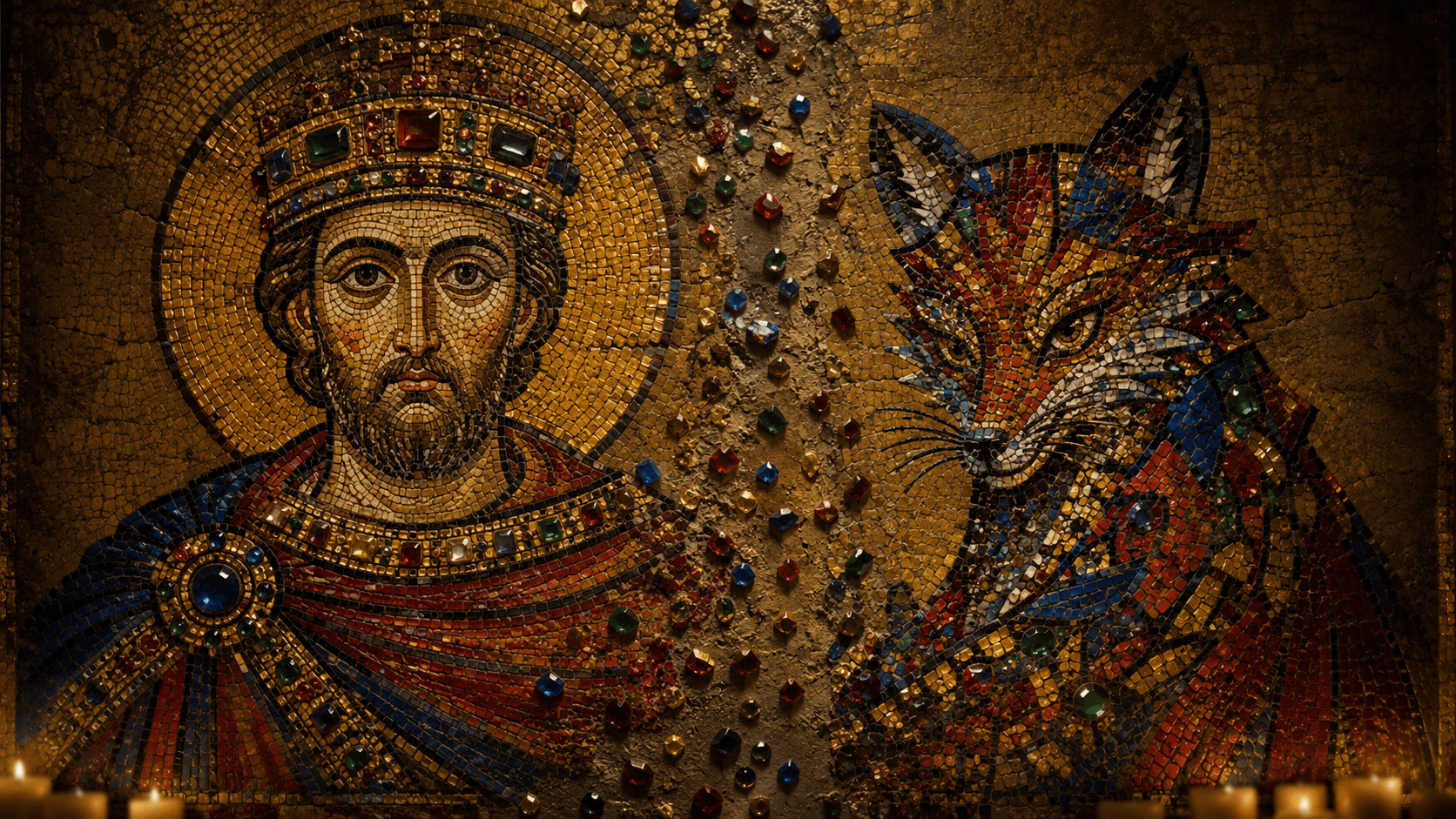
Irenaeus gives another thought experiment. Imagine a master craftsman who has assembled a mosaic — gems set into the portrait of a king. A clever vandal pries the stones loose and reassembles them into the shape of a dog, or a fox, and presents it as the original. The gems are all there. Every one is authentic. And the man who knows the king:
will... recognise the names, the expressions, and the parables taken from the Scriptures, but will by no means acknowledge the blasphemous use which these men make of them. For, though he will acknowledge the gems, he will certainly not receive the fox instead of the likeness of the king. — St. Irenaeus of Lyon, Against Heresies I.9.4
The seeing is immediate, the way you see that a forged signature is not your father's hand — not by deriving it from premises but by knowing the original so well that the lie is obvious. Irenaeus calls the thing that lets him see it the rule of truth (the regula fidei, the received pattern of apostolic teaching), and notice where he locates it: not in a manual the Church consults from outside the text, but in the heart of the baptized, the form by which Scripture is read at all. Strip a man of it and he may be fluent in the words, but he is deaf to the poem.
This is why the accusation of circularity misfires. To recognize the king is not to manufacture him, even if it is not immediately obvious that the mosaic is a king. A faculty that answers to a real object is the opposite of a rubber stamp, because a real object can rebuke you. Let me put the same point through three images the Fathers would have recognized, and translate each so it lands.
Start with the eye and the sun. The eye does not produce light by opening. It receives a light it had no hand in making, and the proof that the light is real and not a private hallucination is that the eye can be corrected by it — can be dazzled, can be shown it was looking at the wrong thing. Now consider the standard demand the critic makes: prove the sun's light without using your sight. The demand is incoherent. There is no inspecting light from a standpoint that does not already involve seeing. Recognition presupposes a light the organ did not create, and asking the organ to validate the light from nowhere is asking it to be something other than an organ of sight. In the same way, asking for the truth of Scripture presupposes that there is an actual truth, and apart from the organ that perceives this, the question is not coherent. The light of the sun is there whether we open our eyes or not, the same way the truth of the scriptures is there, whether we utilize the organ or not.
Take the tuning fork next, because it makes the decisive point about failure. A fork rings when it meets the pitch it was designed for and stays silent at every other. A fork that hummed at every sound in the room would not exactly be performing better. It would be incapable of telling you anything. The Church's phronema (the mind, the disposition, the trained ear of the Body) earns its yes precisely by its capacity to say no. An organ that affirmed everything affirmed nothing.
Then the body itself, which carries us back to where Irenaeus began. A living organism takes in what nourishes it and expels what does not, and it does this without keeping a list of each molecule. It is not democratic; it is alive. The Church metabolizes. She has taken in fathers and councils and expelled Arius and Eutyches not by tabulating opinion but by the reflex of a body that knows what agrees with it. (This same reflex is what lets her honor a great teacher and still reject his errors — but that is a later section's quarry.)
If the organ certifies its own perceptions, what could ever count as a misfire? You have given me a faculty that cannot fail by construction, which is just circularity. Good. Here is the part the critic skips. The tradition gave it a published criterion, with a stated condition under which it returns a no. Vincent of Lérins, in 434, wrote it in a single line that has never been improved on:
we hold that faith which has been believed everywhere, always, by all... This rule we shall observe if we follow universality, antiquity, consent. — St. Vincent of Lérins, Commonitorium ch. 2
Three gates, and a candidate doctrine must clear all three. Everywhere — is it geographically catholic, or is it the enthusiasm of one province? Always — does it reach back through the centuries, or did it surface the day before yesterday? By all — has the body of the faithful consented, or is it the project of a faction? A novelty that cannot show its passport at all three checkpoints is turned away. That is what a falsifiable criterion looks like: it specifies in advance the conditions of its own no. The forger's mosaic fails it. The cento fails it — and the Church has the standing to say so before the fact, not merely to bless the winner afterward.
And Vincent already knew the question this raises against the man who wants Scripture and nothing else, so he answered it before it was asked. If the text alone settled disputes, the disputes would be settled. They are not, and the reason is not obscure:
seeing that the more part, interpreting the divine words according to their own persuasion, take up various erroneous opinions, it is therefore necessary that the interpretation of divine Scripture should be ruled according to the one standard of the Church's belief. — St. Vincent of Lérins, Commonitorium
Every heresy had the Scriptures. Arius had them. The Valentinians had them and used nothing else, recall — only the arrangement was theirs. Scripture interpreted according to one's own persuasion is precisely the cento: real gems, private fox. The standard of the Church's belief is not a second authority bolted on beside the text to outrank it. It is the knowledge of the king, without which the gems can be made to spell anything at all.
V. The Mind has Teeth
The Latter-day Saints have the burning in the bosom: pray over the Book of Mormon, feel the warmth rise, and there is your confirmation. The Watchtower has its faithful and discerning slave, the governing body that alone reads Scripture rightly — and reads it, as luck would have it, exactly the way the last one did. Reach for any sect in any religion and you find the same machine: an inner organ, variously named, that hums approval over whatever the group already holds and falls silent at everything else. The believer calls the hum the Spirit.
You say the phronema recognizes truth. Show me where the organ said no.
The Orthodox have always affirmed that reception has a failure condition, and the failure condition has fired numerous times throughout history, against even bishops, patriarchs, and saints.
Year 449. The Second Council of Ephesus convenes with everything a council could want: imperial summons, imperial money, the patriarch of Alexandria in the chair, the whole apparatus of legitimacy bolted on tight. It deposes its opponents and ratifies its theology. By every external marker available on the day, it is a council just as valid as the others. The Church declined to receive it. Pope Leo handed it the name it has carried ever since, the Robber Council, and within two years Chalcedon had to be summoned to undo its work. All the machinery in the world, and the body would not swallow it.
Year 451. Chalcedon meets, and the Tome of Leo is read into the proceedings. Watch what the fathers actually do with it. They do not stamp it approved because Rome sent it. They measure it line by line against Nicaea, against Constantinople, against the letters of Cyril, and only after the document survives the audit do they acclaim it:
After such great and very severe scrutiny in comparing it with former holy Councils, and a full conviction of the correctness of the meaning, and not merely because it was the epistle of the Pope, they cried aloud... "Peter has so spoken." — Encyclical of the Eastern Patriarchs (1848), §15
Year 1439. At Florence the union of the Eastern and Western Churches is signed: the Byzantine Emperor's hand, and beneath it the signatures of nearly the entire Greek hierarchy that had crossed the sea to sign. Of all the bishops present, only one refused — Mark of Ephesus. And the union died anyway, not because a later council overturned it, but because the faithful back home would not receive what their own shepherds had put their names to. The Emperor and almost every bishop on one side, all of the so-called 'elite'; the body of the Church on the other. The body won.
In May of 1848 the four Eastern Patriarchs — Constantinople, Alexandria, Antioch, Jerusalem, each with his synod — wrote back to Pius IX, who had invited them "home" to Rome. Their reply located the guardianship of the faith somewhere else:
neither Patriarchs nor Councils could then have introduced novelties amongst us, because the protector of religion is the very body of the Church, even the people themselves, who desire their religious worship to be ever unchanged and of the same kind as that of their fathers: for as, after the Schism, many of the Popes and Latinizing Patriarchs made attempts that came to nothing even in the Western Church. — Encyclical of the Eastern Patriarchs (1848), §17
They locate the guardianship in the people themselves, not in patriarchs, or the see of Peter, or anywhere up top. The Patriarchs anchor the claim in history rather than leaving it as a pious flourish: their evidence is the failure record of the men at the top. Innovation handed down from the chair did not stick.
This is the moment a careful reader gets nervous, and rightly. Have we just traded one tyrant for another, swapped the infallible pope or infallible patriarchs for the infallible mob? If the people are the guardian, is doctrine now whatever the crowd will tolerate?
The Fathers were guarding both flanks long before anyone phrased it that way. On the one side, there is a traceable teaching office. Irenaeus could name the bishops of Rome in order from the apostles down, and did, precisely to humiliate the Gnostics who claimed a secret pedigree:
that tradition derived from the apostles, of the very great, the very ancient, and universally known Church... which comes down to our time by means of the successions of the bishops. — St. Irenaeus of Lyon, Against Heresies III.3
And the office carries a gift along with the chair:
obey the presbyters who are in the Church... who, together with the succession of the episcopate, have received the certain gift of truth. — St. Irenaeus of Lyon, Against Heresies IV.26.2
Here is where the fear of the mob comes apart. That sentence almost always gets quoted to exactly that point and no further. Irenaeus, though, finishes it:
But [it is also incumbent] to hold in suspicion others who depart from the primitive succession... For all these have fallen from the truth. — St. Irenaeus of Lyon, Against Heresies IV.26.2
Notice that the obedience is not tied to the chair as a bare fact, but the succession reaching back to the beginning — and that is the force of the word primitive, the original deposit, not merely the man currently holding the seat. The charism rides with the office only so long as the office keeps faith with what it received. Irenaeus never commands obedience to a man because he holds the title; he commands it to the one who holds the title and the deposit together, and in the same breath he tells you to be wary of whoever has let go of either. The gift of truth is entrusted, never owned. A bishop is the deposit's steward, and a steward who trades away the thing he was set to guard has already abandoned his office and therefore is no longer expected to be followed.
Now read the Florentine bishops through Irenaeus's rule. The hierarchy that crossed the sea and signed had not been overruled by a larger faction because the Church is not a democracy. They had departed from the primitive succession — the faith their own predecessors had held and handed down, which it was their whole commission to keep and not to spend. The faithful at home who refused them were not breaking with the episcopate. They were holding the episcopate to the one condition that makes a bishop's word binding.
If that still sounds abstract, here is the same architecture in the one place modernity rebuilt it from scratch: Bitcoin. The network does not run by ten thousand miners each going off alone, reasoning privately, and happening to land on the same answer. That would be every-man-his-own-pope, and it would converge on nothing. What happens is the reverse. There is one received history — the chain of blocks running unbroken back to the genesis block, the single origin every participant holds in common — and no node ever generates truth against it. Each node checks every new candidate against that entire inherited record: does this coin trace back through the chain, is it signed by the key that actually controls it, has it already moved. A block that contradicts the history is not put to a vote. It is rejected on sight, and the chain carrying it is pruned — orphaned, dropped, abandoned — no matter how much computing power was burned to build it. Consistency with the whole received past is what buys a block its place.
The genesis block is the deposit handed to the apostles. The chain is Tradition: not a heap of opinions but one continuous record reaching without a gap to the origin. And recognition is just what every node performs — not deriving the faith afresh in isolation, but measuring each new claim against everything already received and refusing whatever will not cohere with it. Arius broadcast a block that did not trace back to genesis. The network pruned it. This is also a perfect explanation as to why debates like Arianism and Unitarianism do not need to be rehashed every generation. Every new block commits to the entire history behind it, and the rules are preserved very carefully, so we can trust that the defeat of the Arians was preserved up until now, the same way I can trust that chain every node holds still carries the transaction I made three years ago.
No analogy is perfect, but the place this one strains turns in the Church's favor. You might call Bitcoin a democracy of sorts — its rules hold by agreement, and a large enough majority could fork off and run new ones. Yet even that overstates it, because a hostile majority cannot rewrite history. With fifty-one percent of the power the most an attacker can do is forge new blocks going forward; the chain already behind him is sealed by the accumulated work stacked on top and redoing that work is a computational nightmare that, in all practicality, can never be done. That is exactly the Church's situation: even if every living bishop went corrupt tomorrow, we would still have the Fathers, the councils, the whole settled chain behind us. What the deposit adds is that not even the future is open to amendment. No council, no plebiscite of the faithful, can vote the Son back into being a creature. The rule the Church measures against was received, never set by the network, and reception is recognition, not authorship (see II). So the Church comes out less circular than Bitcoin, not more: Bitcoin bottoms out in human consensus, however robust; the Church bottoms out in a deposit from Christ. (I have made the monetary half of this case in my other essays on Bitcoin — why proof-of-work secures anything, why a money no ruler can inflate is the only honest kind. It would be very useful to give those a read. Bitcoin is an ethical monetary unit and conveniently gives a great analogy to understanding Orthodox ecclesiology).
Ask why an attacker holding a majority of the world's mining power — the famous fifty-one percent — does not just seize the chain and counterfeit at will. Nakamoto had this in mind from the start — the moment such an attacker openly breaks the rules, he destroys the value of the very thing he is trying to hoard. The whole pile his power was meant to swell is worth something only while the network is trusted to be incorruptible. Corrupt it and the wealth dies in his hands. The man with the most power to break the system is the man with the most to lose by breaking it. Now look again at Florence, and at every elite who ever tried to hand his people a new faith from the top. His authority was denominated in one currency only: fidelity to what the Church had received. The signing hierarchy did not gain Rome and keep their flocks. They spent their standing and walked away holding neither. Power exercised against the historic Church is power that liquidates itself in the act.
So the mind of the Church is not the democracy the objection assumed. It has pruned the blocks of emperors and popes, orphaned its own councils, refused unions its own bishops signed and broadcast to the world.
VI. No Father, No Majority, Is a Checkmate
Take the first of the two debts left standing at the end of the last section. You claim the Body recognizes the truth by a faculty the Spirit gives it. Then account for Origen. Account for Tertullian. Account for Cyprian — bishop of Carthage, confessor, a man who would give his head for Christ under Valerian — who taught on the question of rebaptism a doctrine the Church declined to keep. If the phronema is real, how does it misfire in the very men who possessed it most fully? And if it can fail in a saint, what is it worth in anyone beneath him?
The objection assumes the Church never saw this coming. Vincent of Lérins built his entire canon around precisely this problem — the great teacher who goes wrong — and he opens the wound himself, naming the two largest names within reach. Origen, first among the Greeks. Tertullian, first among the Latins.
if at any time a Doctor in the Church have erred from the faith, Divine Providence permits it in order to make trial of us, whether or not we love God with all our heart and with all our mind. — St. Vincent of Lérins, Commonitorium ch. 17
He is reading the fallen Doctor through Deuteronomy 13, where Moses warns that a prophet may arise, may even work a sign that comes to pass, and still be sent as a test — God letting the wonder stand to see whether His people love Him more than they love a marvel. Origen's learning was vast and genuine. The very size of the man is what qualifies him to be a trial.
So the Church does not weigh a teaching by the stature of whoever advanced it. She has a procedure, and Vincent laid it out a few chapters earlier. Everywhere, always, by all — but applied as three successive filters, each catching what the last let pass. An error penned in one province is answered by universality: the rest of the world never held it. A novelty that has spread wide is answered by antiquity: the centuries before it never knew it. And where even antiquity is muddied — where one or two great teachers in the past can be shown to have slipped — the test is consent, the many against the few.
One teacher, however towering, set against the agreement of the whole is by definition not the agreement of the whole. Vincent says exactly that:
But if any one among them, be he ever so holy, ever so learned, holds any thing besides, or in opposition to the rest, that is to be placed in the rank of singular and private opinions, and never to be looked upon as the public, general, authoritative doctrine of the church. — St. Vincent of Lérins, Commonitorium ch. 28
Be he ever so holy, ever so learned. The holiness is conceded in the same breath it is set aside.
No single Father is inerrant, and the Orthodox have never pretended otherwise. We keep Augustine on the calendar as a saint and hold, in the same breath, that he was wrong about a good many things. He would have been the first to grant it. Watch how carefully he draws the line:
I have learned to yield this respect and honour only to the canonical books of Scripture: of these alone do I most firmly believe that the authors were completely free from error... As to all other writings... I do not accept their teaching as true on the mere ground of the opinion being held by them. — St. Augustine of Hippo, Letter 82
A Protestant reads that and hears his own thesis handed to him whole: Scripture inerrant, everything beneath it fallible, therefore Scripture and Scripture alone. He has the first half exactly right. The canonical authors, and none below them, were kept free from error; no other writing earns Augustine's belief "on the mere ground of the opinion being held by them." Two things follow, and the Orthodox affirm both. First, no writing outside the canon is wholly without error — were it otherwise, it would be in the canon. Second, and here the Protestant reads too quickly, Augustine has left himself a criterion. He does not refuse a teaching because fallible men hold it. He refuses it when it rests on nothing sturdier than the man who holds it. The phrase he chose: the mere ground of the opinion being held by them. What he turns away is the bare opinion of a lone writer, and behind that writer stands something he does not turn away — the agreement of the Church.
Read on in the same letter and the distinction becomes Augustine's own. The man who has just reserved unconditional belief to the canon turns, a few paragraphs later, to two of the very Fathers he would never call infallible:
However, if you inquire or recall to memory the opinion of our Ambrose, and also of our Cyprian, on the point in question, you will perhaps find that I also have not been without some whose footsteps I follow in that which I have maintained. At the same time, as I have said already, it is to the canonical Scriptures alone that I am bound to yield such implicit subjection as to follow their teaching, without admitting the slightest suspicion that in them any mistake or any statement intended to mislead could find a place. — St. Augustine of Hippo, Letter 82 §24
Augustine binds his implicit subjection to the canon and to nothing under it, and that he never lets go. Yet beneath it he is not therefore a man alone with his Bible and his own lights. He plants his teaching inside a line of witnesses who held it before him, and its weight comes from that company rather than from any cleverness of his own, however clever he may be. The thing he leans on is the reading the Church had already been keeping. Ambrose and Cyprian are not infallible. What he trusts is their agreement. The solitary opinion of any one of them he would have set down without a second glance, exactly as his own rule demands.
So the Protestant has carried the wrong lesson away from a page that teaches its opposite. Augustine reserves unconditional trust for the canon so that he will never crown a single fallible man — himself first of all — as its rival. And with the same discipline he declines to read that canon alone, by his own persuasion, because he has already seen where private persuasion leads (recall the cento — real gems, private fox). The footsteps he follows are the mind of the Church walking on ahead of him. He would doubt his own eyes before he doubted the Church, and this becomes blatantly obvious in his writings on how he came to believe anything at all. Pressed by the Manichees, who wanted him to receive their founder as an apostle on the authority of the gospel, he refuses — and in refusing, he explains why the gospel has a hold on him in the first place:
For my part, I should not believe the gospel except as moved by the authority of the Catholic Church. — St. Augustine of Hippo, Against the Epistle of Manichaeus Called Fundamental, ch. 5
Augustine does not hold the gospel first and then, as a courtesy, tip his hat to the Church that carries it. He holds the gospel because the Church handed it to him and vouched for it. Withdraw her authority and, on his own testimony, his confidence in the text goes out with it. Which is precisely the knife he turns on the Manichees: the same authority that commended the gospel to me is the authority that forbids me your apostle, so on what honest ground would I keep the one and spend the other? The book and the body reached him in the same hand. He cannot cut the hand off and keep only the book.
And he says what that authority is actually made of:
The consent of peoples and nations keeps me in the Church; so does her authority, inaugurated by miracles, nourished by hope, enlarged by love, established by age. The succession of priests keeps me, beginning from the very seat of the Apostle Peter... down to the present episcopate. — St. Augustine of Hippo, Against the Epistle of Manichaeus Called Fundamental, ch. 4
Consent of peoples and nations — everywhere. Established by age — always. A succession of priests running unbroken from the apostles to the bishops of his own day — the chain from Section V, the blocks stacked back without a gap to the genesis block. This is no private argument of Augustine's own devising. It is the same threefold recognition Vincent would write down a generation later, again showing the belief was in the church before the wording, and Augustine names it as the very thing that holds him in place. The man who reserved unqualified belief to the canon anchored his grip on that canon in the consent, the antiquity, and the succession of the Church.
Cyprian is the case that proves it, which is why Vincent lists him among the fallen. A bishop, a saint, a martyr venerated to this day. He held that converts baptized by heretics had to be baptized again. The Church declined to receive it. The contrary practice was normalized at Nicaea and after, and Cyprian's position simply never entered the mind of the Church. Augustine, answering the Donatists who later tried to shelter behind Cyprian's name, made the ruling that keeps both truths standing at once: Cyprian's error was covered by his charity and sealed by his martyrdom, and the Donatists had no claim on him whatever, because the one thing Cyprian never did was break communion over it. He stayed inside the Body whose verdict went against him, and trusted in the Spirit to work the Truth out in the Church, however he might err.
Gregory of Nyssa entertained the restoration of all things, what a modern reader would recognize as something like universalism, that in the end all things might be restored to communion with God, potentially even Satan. The Church declined to dogmatize it while never ceasing to honor him as a saint and a theologian of the first rank. Origen was anathematized in the sixth century and is still mined for insight. The Church metabolizes — the same reflex from the fourth section, the living body taking in what nourishes and passing what does not.
That disposes of the lone Father. Grant that one teacher against the many is outvoted by the many. What happens when the many are the ones who err?
Look at the fourth century and you find long stretches where the Arian and semi-Arian party held the majority of sees, the ear of the emperor, the working machinery of the Church. Look at the seventh and you find Monothelitism endorsed up and down the hierarchy, every major patriarchal see either in communion with it or compromised by it. The body itself, counted heads-down on the wrong afternoon, can come back wrong against a remnant of the faithful.
The mind of the Church is not the show of hands in 357; it is what the whole Body, looking back, cannot help but acknowledge as the Spirit's own voice — and that judgment is rendered over generations, never at the height of a crisis when the count is at its worst.
Maximus the Confessor was hauled before the authorities and pressed with the plain fact that every see, every patriarch, the whole communicating world had gone over to the Monothelite confession. He answered with this:
"Christ the Lord called that Church the Catholic Church which maintains the true and saving confession of the Faith. It was for this confession that He called Peter blessed, and He declared that He would found His Church upon this confession." — The Life of Our Holy Father St. Maximus the Confessor
And when they pushed harder, he gave them the sentence that cost him his tongue and his right hand:
"Even if the whole universe holds communion with the Patriarch, I will not communicate with him." — St. Maximus the Confessor
A careless reader hears private judgment here and the whole argument of this essay folds into the Protestantism it has been answering. Maximus never appeals to himself. He appeals to the true and saving confession — the antiquity and the consent that the present majority had walked away from. The agreement of the centuries against the agreement of the room.
And the crowd, in time, came back to where they stood. Athanasius — later tagged contra mundum, against the world, a phrase he never used of himself — was exiled five times while the Arian party ran the empire's churches. Nicaea was true the day it was signed in 325. But it was not universally received, not settled into the agreement of the whole Body, until something like Constantinople in 381 — better than half a century on. For most of that span the remnant looked like the loser. What vindicated it was time. Across two generations the Body recognized which confession had been the Spirit's all along and which had been the test.
So the majority at any single moment is not the mind of the Church. Which leaves exactly one question still open. If a council is not true because the Body received it, but received because it was already true, then reception is doing something far stranger than the word lets on.
VII. Convenient for Whom, Exactly?
At last we bring back the charge from section I. Convenient. The whole indictment turned on the image of a Body that grades its own work and claims to be inspired by the Holy Spirit — a system arranged in advance never to be told it is wrong by anyone it is bound to hear. Let's flip the question; convenient for whom?
Begin where every theory of knowledge has to begin, whether it admits the debt or not. There is no reading from nowhere. Hand him his own Bible and watch the same thing happen to him. He opens it; he reads; he arrives at a meaning. By what? By an interpreting faculty seated entirely inside his own skull, answerable to no one. He sits himself in the circle he claims the Orthodox stands in.
So the question was never internal check versus external check. The real question is which authority you will trust to do the recognizing. On one side: a single reader, one lifetime deep (if that), with no antiquity behind him, no universality around him, no consent to answer to, free to overturn on Tuesday what he was certain of on Monday and to claim both as under the leading of the Spirit. On the other: the communion of the Spirit-bearing dead (sleeping) and living, twenty centuries wide, run through the three gates Vincent set down in 434 — everywhere, always, by all.
Set the two side by side and ask which one is built for the comfort of its occupant. The Protestant reader sits as plaintiff, sole witness, presiding judge, and court of final appeal in his own cause. His interpretation always prevails — there exists no tribunal above it he is obliged to hear (if you make the solo vs sola argument here, refer to my other piece against sola scriptura, where I have shown that sola scriptura boils down to solo in practicality). He cannot be outvoted, having abolished the vote. He cannot be corrected by the dead, having granted the dead no standing. He cannot be bound by anyone not yet born, because the text means what it means to him, now. And when his reading settles on a conclusion he favors, it is simply the plain sense of Scripture, the inward witness of the Spirit upon his heart. He certifies his own opinion and then reads the certificate back to himself as evidence.
Let us press on. The Protestant decides, for himself, which doctrines are essential and which are secondary — which articles a man must hold to be saved, and which he may take or leave without peril to his soul. And by what recurring miracle does the line fall almost exactly where it must to keep him, personally, on the safe side of it? Baptism, the Eucharist, the structure of the Church, the communion of the saints — quietly relocated to the non-essentials, matters on which sincere men may differ. What survives in the essential column? How striking that it would be the short list of things he already affirms. If we are hunting for a faculty that ratifies whatever its owner already believes and submits to nothing outside itself that could, in principle, return the other answer — the argument against Orthodoxy in Section I — we have found it, but it more strikingly applies to the Protestant.
Vincent knew the danger, and warned of it, because it was already happening in his time. The disputes are not closed by Scripture alone, he wrote, for a plain and unflattering reason:
seeing that the more part, interpreting the divine words according to their own persuasion, take up various erroneous opinions... — St. Vincent of Lérins, Commonitorium
According to their own persuasion. Real gems, private fox.
And here the word convenient finally snaps in the critic's hand, because the men who actually carried the mind of the Church had anything but convenient lives.
Was it convenient for Maximus the Confessor? When the whole imperial Church had gone over to Monothelitism and when he would not follow, they tried him, and when argument failed they punished him. They cut out his tongue so he could no longer confess the faith aloud, and severed his right hand so he could no longer write it down. The State amputated his tongue and hand for the express reason that the truth was not, to him, negotiable. He died in exile in the Caucasus, mutilated, on the losing side of every synod that sat during his lifetime. He had said it while he still had the tongue to say it: even should the entire universe commune with the heretic, he would not. Convenient is not the word that comes to mind.
Was it convenient for Ignatius of Antioch? Arrested under Trajan and marched across Asia to die for an afternoon's entertainment in a Roman arena, he wrote ahead to the Christians of the capital with one fear: not that he would die, but that they might love him enough to pull strings and stop it. He begged them to do nothing:
I am the wheat of God, and am ground by the teeth of the wild beasts, that I may be found the pure bread of Christ. — St. Ignatius of Antioch, Epistle to the Romans 4
No man writes that sentence about a doctrine he holds because it flatters him.
Was it convenient for Athanasius, driven from his see five times across forty years, the inhabited world gone Arian around him while he stood nearly alone? Was it convenient for Mark of Ephesus, the lone bishop at Florence who refused the pen, who watched the assembled Greek hierarchy sign their names to the union? This is the price the Church's witnesses paid to recognize the king and decline the fox. Now weigh it against what the critic stakes. He binds himself to nothing he cannot revise by morning. He answers to no court he cannot adjourn at will.
One honest question remains. If a council only binds once the Church "receives" it, is the truth of it just decided by a later vote after all?
The answer is to see that reception was never ratification. A council does not become true because the Church accepts it; the Church accepts it because it was already true. The false councils came with every imperial advantage and failed to take root anyway. The true ones were known. Reception is the Church proving, across time, that she cannot be permanently deceived.
The phronema is the standing promise that the gates of hell shall not prevail, worked out in the slow vindication of the remnant over the crowd, of the dead over the fashionable, of Athanasius over the synods that exiled him. The body does not author the King, it simply fails to mistake Him for a fox.
The convenient faith is the one that costs its holder nothing, binds him to no one, and leaves the final vote in his own grip for life. By that measure the man who can be martyred for refusing to revise is the single creature in this whole dispute who is plainly not choosing what is convenient. How such a man comes to know the voice he would sooner lose his tongue than deny is a different matter altogether — and not, it turns out, a matter of argument.
VIII. The Mystical Core — What the Syllogism-Hunter Cannot See
Through this whole essay the critic has wanted one thing: a proof he can check from the outside. Lay out all the reasoning and details and let him test it the way he would test a math equation. And until now he has mostly gotten that — arguments he can follow and weigh for himself.
But there is something underneath all those arguments that does not fit on paper, and the moment the Orthodox admits as much, the critic thinks he has won. So when you are finally pressed, you stop arguing and start talking about feelings.
He is wrong, but not because the inward part is not real. Recognizing the truth is something the Holy Spirit does inside a person — and saying so is not a retreat from the argument. It is the claim the argument has been driving at since Section II, where we said the truth in question is not a theorem but a Person. You do not prove a person on paper. You come to know him, and you learn his voice. So what follows is not a dodge but a description: how the knowing actually happens. The Fathers spent centuries describing it.
Start with Augustine. The Spirit does not hand you facts from outside; He changes your mind so that it can see for itself. Reading the sixteenth chapter of John, where Christ tells the disciples there is more He cannot yet say to them, Augustine writes:
not from outward teachers will you learn those things which the Lord at that time declined to utter, but be all taught of God... your minds themselves may have the power to perceive. — St. Augustine of Hippo, Tractates on the Gospel of John
The knowledge is not delivered by an outside teacher. The mind itself is changed so that it can perceive. This matches the verse Augustine is reading — when he, the Spirit of truth, is come, he will guide you into all truth (John 16:13, KJV) — and it matches what John says in his first letter: the anointing which ye have received of him abideth in you... the same anointing teacheth you of all things (1 John 2:27, KJV). The anointing is the teacher. It is inward and is given, and it is exactly what the critic keeps demanding the Church put aside.
A man who receives this gift is changed by it, and the Fathers were not shy about how far. Florensky, drawing on the ascetic tradition, quotes Macarius the Great:
"He who possesses grace," says the Venerable Macarius the Great, "possesses another mind, another understanding, and another wisdom than the wisdom of this world." He is in all things other; he is a monk. — Pavel Florensky, The Pillar and Ground of the Truth
This is the mind of the Church seen from inside a single person. It is not an opinion he reasoned his way to. What pride would it be to assume by our own reasoning we can reach God (this is precisely the point of the nous — see my other works). Kallistos Angelikoudes describes the climb — the nous, the eye of the soul we met back in Section II, lifted up out of argument and into the sight of God:
as the eye of the soul, that is, the nous, turns and frequently beholds... it is raised up... toward contemplating and toward truly being occupied with the One who is, and to delighting in the heavenly things, and in the radiances of truth. — St. Kallistos Angelikoudes, On Union with God and the Life of Theoria
The truth is not deduced by the rational mind, per se. A man who has seen it knows the voice that speaks it, the way a son knows his father's voice across a crowded room. Christ said exactly this about His own sheep:
My sheep hear my voice, and I know them, and they follow me. — John 10:27 (KJV)
And about the stranger:
a stranger will they not follow, but will flee from him: for they know not the voice of strangers. — John 10:4–5 (KJV)
Christ says His sheep know His voice, not His words. Arius used the Shepherd's own words to say the stranger's thing, and the body fled.
This might revive the old worry: if recognition happens inside a person, haven't we landed back at every man for himself, every believer his own pope? No — because the line between what is the Spirit in a man and what is merely the man runs through the same test we have used all along: everywhere, always, by all. A perception that clears the three gates is the Spirit's; one that fails them is only a private persuasion. The faculty is inward, but its verdict is checked against the whole Body across all of time.
And that is how the gift worked the first time the Church had to decide anything. The apostles did not each go off, pray alone, and compare notes afterward. They gathered, argued it through, and wrote:
For it seemed good to the Holy Ghost, and to us. — Acts 15:28 (KJV)
The Holy Ghost, and us. Not the Spirit working through them after the fact — the Spirit and the gathered Church. This was the Council of Jerusalem, around the year 49, the model every later council copies.
That is why the Church endures the strange way she does, and here Hilary of Poitiers — who lived through exile and the long Arian years himself — says:
It is the peculiar property of the Church that when she is buffeted she is triumphant, when she is assaulted with argument she proves herself in the right, when she is deserted by her supporters she holds the field. — St. Hilary of Poitiers, On the Trinity
She proves herself right when she is attacked. Hilary does not say she wins by out-arguing her attackers. A cause kept alive by clever men collapses the day the clever men walk away. When Athanasius stands almost alone, when Maximus has lost his tongue, when Mark of Ephesus is the only man in the hall who will not sign, there is no honest word for the Church's victory but the one Hilary reached for. Peculiar. Mystical. Mysterious.
IX. The Church Listening
The charge, stripped to its frame, was a demand: step outside the faith and prove it from no standpoint at all. Stand nowhere, and from nowhere certify that the Church is right. I have spent eight sections answering smaller versions of this. The critic who set the demand cannot meet his own standard. He cannot step outside his own mind to prove that his reason is sound.
The question was never private certainty against external proof. It was always which witness you trust to do the recognizing — a question every man answers, the critic included, the moment he opens a book and arrives at a meaning.
What the Church offers in place of the proof he wanted is stranger, and far more humble. Not a syllogism kept in reserve, but a claim about what truth is. Truth is not a proposition she derived and now guards; it is alive, a Person, the one who said I am the way, the truth, and the life (John 14:6, KJV) and through whom the world was made. A living truth is not held the way a theorem is held. Irenaeus said it of the Church near the start of this essay, and it is where the essay has to end:
this gift of God has been entrusted to the Church, as breath was to the first created man, for this purpose, that all the members receiving it may be vivified. — St. Irenaeus of Lyon, Against Heresies III.24.1
Adam did not author the breath that made him a living soul. He received it, and lived. The Church stands in precisely that posture toward everything she holds. To call her doctrines convenient, a circle flattering itself over opinions it finds agreeable, you have first to believe she manufactured them. She has never once said she did. What she says instead is that she knows a voice.
My sheep hear my voice, and I know them, and they follow me. — John 10:27 (KJV)
The heretics had His words — every syllable, recall, arranged into a fox. That is the faculty the critic kept ordering her to set aside, and it is the one thing she cannot set aside and remain herself. Hilary, who lived the Arian decades from inside his own exile, named the peculiar shape this takes in history:
when she is deserted by her supporters she holds the field. — St. Hilary of Poitiers, On the Trinity
A cause carried by clever men dies the afternoon the clever men leave. The Church kept the field with Athanasius nearly alone, with Maximus short a tongue, with Mark of Ephesus the only unsigned name in the hall. No body congratulating itself behaves that way. That is the conduct of a Body straining to hear something it did not invent and would sooner be mutilated than mishear.
Reminder
These are one layman's workings-out. I am not your priest. On anything that touches doctrine, take what I have set down here and cross-examine it with one — which is itself the method I have been defending the entire way, the single reader bringing his reading under the mind of the Church.