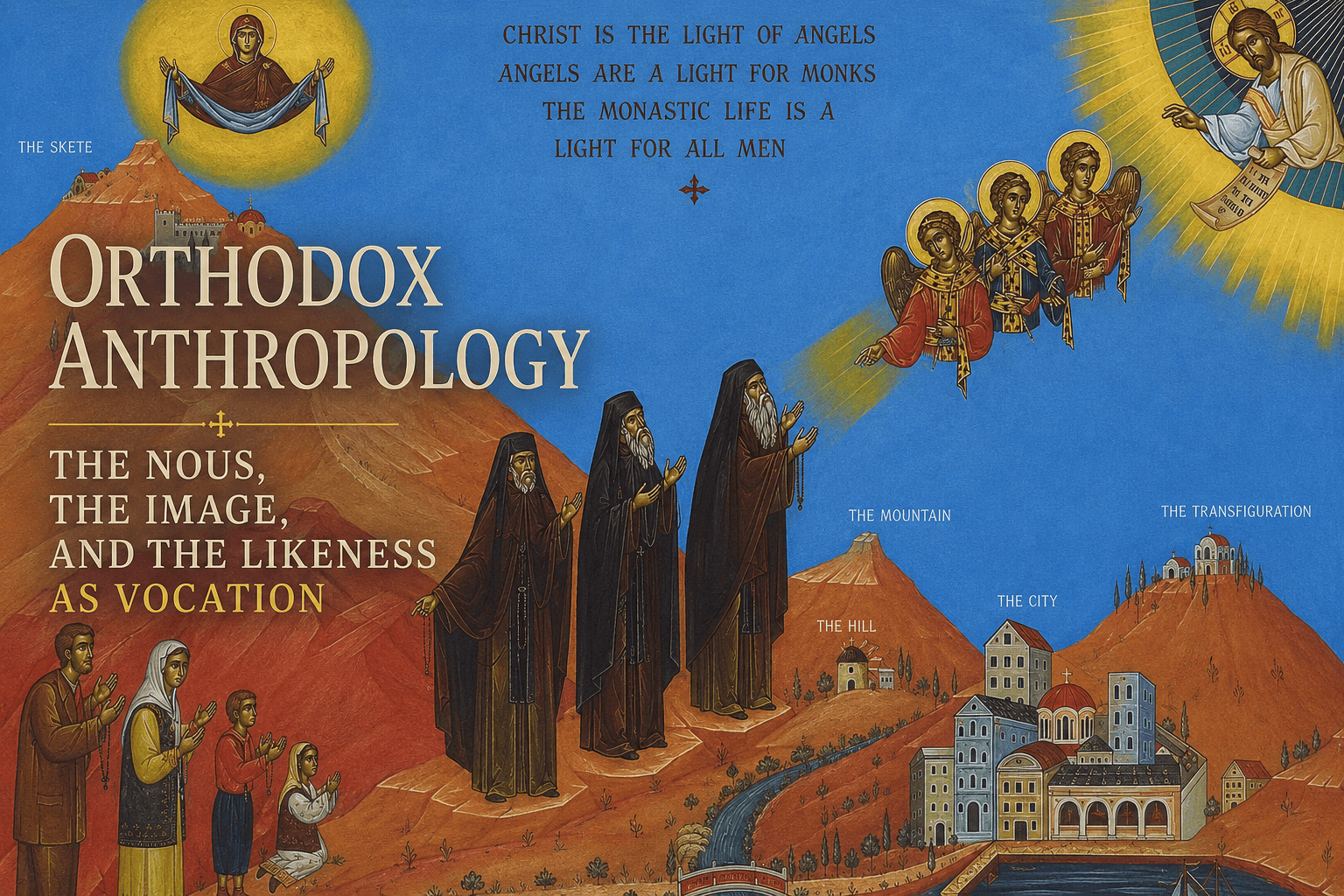
I. Introduction: The Grand Symmetry
"He assumed the worse that He might give us the better; He became poor that we through His poverty might be rich; He took upon Him the form of a servant that we might receive back our liberty; He came down that we might be exalted; He was tempted that we might conquer; He was dishonoured that He might glorify us; He died that He might save us; He ascended that He might draw to Himself us, who were lying low in the Fall of sin."
~ St. Gregory of Nazianzus, Select Orations
It's the same thing said eight different ways. God descends so that man might ascend. The Creator empties Himself into the form of a creature so that the creature might be filled with the life of the Creator. The whole of Christianity, in one sentence.
The modern Western Christian, and I include the Protestant tradition I was raised in, has inherited a version of the gospel that has been progressively flattened, until what remains is largely a transactional account: God is angry, Christ pays the bill, you sign the receipt, you go to heaven when you die. There is truth in pieces of this, but this legality is to the patristic vision what a wedding contract is to a marriage. The legal instrument is real but is also not the thing.
The thing is what Gregory just said. He came down that we might be exalted. The Greek fathers had a word for the descent -- kenosis, the self-emptying of God in the Incarnation, drawn from Philippians 2 where Paul says Christ "emptied himself, taking the form of a servant." They had another word for the ascent -- theosis, sometimes rendered as deification, the participation of the human person in the divine life. These are not two separate doctrines awkwardly bolted together but rather are one motion. They are the same act, viewed from opposite ends. The Incarnation is the door God opened by walking through it Himself, in the only direction the door could possibly be opened.
This is the central insight of Orthodox theology that binds together every other doctrine I want to examine in this piece.
Once you see the symmetry, you start to notice that a great deal of Eastern Christian theology that looks, from the outside, like dense metaphysical hair-splitting is actually doing one thing: protecting the faith. Guarding it from collapse. Making sure that when we say God became man so that man might become god (and yes, the fathers really did say this, Athanasius said it almost word for word) we do not mean it in a way that obliterates the difference between Creator and creature.
Take the essence/energies distinction, which I'll develop properly later. The fathers needed a way to say that we genuinely participate in God, not in a metaphor, not in a legal fiction, but really, while also saying that the divine essence remains absolutely, eternally, ontologically beyond our reach. So they distinguished what God is in Himself from what God does outwardly, what He gives of Himself. We participate in the energies. The essence is His alone.
Without that distinction, you have to pick one of three heresies. Either God is unreachable and theosis is just rhetoric. Or we become little gods in the polytheistic sense and Christianity collapses into something else entirely. Or -- and this is the option the Christian West eventually took -- the grace by which we are saved is created, a manufactured intermediary, something God makes and then hands us, rather than God Himself communicated to us. If grace is created, then we are not actually participating in God; we are participating in a thing God made, the way we participate in any other creature. How can humanity be saved by a creature? The symmetry collapses. We are saved by a product of the divine rather than by the Divine.
The essence/energies distinction is the wall that keeps all three heresies out and the bridge standing.
This is the pattern. Every distinction the fathers fought for serves the faith. The two natures of Christ, undivided and unconfused. The two wills of Christ, neither absorbed into the other. The Trinity as three persons in one essence. The nous versus discursive reason. The soul versus the spirit. None of these are abstractions for their own sake. They are the load-bearing structure of a single claim: that the infinite God has made Himself genuinely available to finite persons, and that finite persons are made to be genuinely filled with Him, and that this is not a contradiction.
So here is the point of this article (two part series), as plainly as I can put it.
The doctrines I want to examine (the nous and its restoration, the essence/energies distinction, the soul-spirit anthropology, the meaning of theosis, and the kenotic shape of Christ's life) are not five separate topics. They are one vision, seen from five angles. They describe a single reality: the personal communion of God and man, made possible because God descended into our condition, and made consummate because we are drawn up into His. Take any one of these doctrines in isolation and you will misread it. Hold them together and they hold each other up.
A note before I go further. I am not a priest. I am writing as a catechumen who came up in a Protestant church, started reading the apostolic and Greek fathers expecting to be reassured, and found instead that I had been handed a tradition far older, stranger, and more demanding than I had been led to believe. What follows is the working-through. Anyone who reads this and finds the arguments compelling should take them to an Orthodox priest and pressure-test them properly. I am working out loud. That is all.
If God came down so that we might be lifted up, then the way we are lifted up is by following Him into the descent. The cross before the resurrection. The kenosis before the theosis.
II. The Nous: The Faculty Made for God
Ask a modern Christian what part of him is made to know God, and you will get an answer about the heart, or maybe the soul, or possibly just a shrug. The question itself sounds slightly embarrassing, like asking which organ is responsible for love. We have inherited a vocabulary that flattens the interior life into two domains: thinking and feeling. Reason and emotion. Head and heart. And then we wonder why the spiritual life feels like an exercise in either intellectual assent or emotional self-management.
The Fathers had a third word. They thought it was the most important one.
A. Nous, not mind
The Greek is νοῦς (nous). It is usually rendered "mind" in English translations, which is part of how we lost it -- because mind in English means the thing that does math, drafts emails, and rehearses arguments. That faculty exists, and the Fathers had a word for it: dianoia, discursive reason, the linear, step-by-step movement of thought from premise to conclusion. Dianoia is what you are using right now to read this sentence.
The nous is something else. It is the contemplative summit of the soul, the eye of the heart, the faculty of direct spiritual perception. It does not reason toward God by chains of inference; it sees. It is the part of you designed to behold, not to calculate. When the Beatitude says "blessed are the pure in heart, for they shall see God" (Matt. 5:8), the seeing is not metaphor. It is a real act of a real faculty. One that, in fallen man, is darkened, distracted, and largely asleep, but never destroyed.
Hold onto the distinction. Almost every confusion about prayer, theology, and the spiritual life in the modern West reduces, in the end, to collapsing the nous into dianoia -- treating contemplation as a kind of careful thinking, when it is in fact a different operation entirely. We cannot reach God through intellectual discourse and doctrinal development as science or math become more advanced, and while Fathers such as Saint Justin Martyr posit that true rationality is participation in the Logos, this is precisely the opposite of what the modern reader hears when he encounters the claim. Justin is not saying that better arguments get you closer to God. He is saying that the rational structure of the world is itself the imprint of Christ, and that the mind comes into its truest operation when it is conformed to Him -- not when it has reasoned its way up to Him.
B. The chain of images
Once the term is in hand, the Fathers do something audacious with it. They place the nous inside a Trinitarian and Christological architecture that runs straight back to Genesis.
The Logos -- the eternal Word, the Son -- is the image of the Father. This is straight from Paul: "He is the image of the invisible God, the firstborn of all creation" (Col. 1:15). The Son is what the Father looks like when the Father expresses Himself. The Alexandrian tradition then takes a further step. If the Son is the image of the Father, and man is made in the image of God, then the image of God in which man is made is, specifically, the Son. Man is the image of the Image.
Eusebius states it cleanly:
"For the image of God is the divine and royal Word, the impassible Man; and an image of that image is the human mind."
~ Eusebius of Caesarea, Praeparatio Evangelica
Notice what this does. It locates the imago Dei in man not as a vague resemblance like upright posture, or rationality in the abstract, or moral capacity, but in the nous (remember it renders as mind in English) specifically, and it ties that nous directly to Christ. The faculty in you that is made for God is made in the shape of the One who is eternally turned toward the Father. To use it rightly is, structurally, to participate in the Son's act of beholding the Father. To misuse it and turn it toward idols, distractions, orthe self is to misuse the part of you that is most intimately Christ-shaped.
This is why the Fathers take the interior life so seriously. What you do in your nous is what you do with the part of yourself that most resembles God.
C. The nous as reflection of the divine Mind and Word
Gregory of Nyssa pushes the architecture deeper. If the nous is the image of the Image, then its very structure (its capacity to hold a thought and utter a word, to mean and to express) is itself a created analogue of the Trinitarian life:
"The Godhead is mind and word: for 'in the beginning was the Word' and the followers of Paul 'have the mind of Christ' which 'speaks' in them: humanity too is not far removed from these: you see in yourself word and understanding, an imitation of the very Mind and Word."
~ St. Gregory of Nyssa, On the Making of Man
Read that twice. Gregory is not saying that man, as a bundle of mental faculties, is approximately God-like in a generic way. He is saying something far more specific: the relation between your understanding and the words it generates is itself an imitation, in created and finite mode, of the relation between the Father and the eternal Word. You are not simply made by a Trinitarian God; you are made in the grammar of a Trinitarian God. Mind and word, intellect and expression are all imprints of the divine onto your nature.
D. The nous as site of pneumatological operation
But the nous is not a self-sufficient faculty. It is not a private telescope you can train on God by your own effort, given enough discipline. The Fathers are clear that it is, by nature, capable of perceiving the divine, but its actual elevation to that perception is the work of the Holy Spirit. Basil:
"If on the other hand it assents to its diviner part, and accepts the boons of the Spirit, then, so far as its nature admits, it becomes perceptive of the divine."
~ St. Basil the Great, Letters
Two things are doing work in that sentence. First, the soul has to assent, here there is a freedom and a choice involved; the Spirit does not override the will. Second, the perception of the divine is "according to nature" but not from nature alone; it requires the "boons of the Spirit." The nous is the faculty; the Spirit is what wakes it up.
Don't pass over this too quickly. The nous is not a some obscure thing to dismiss lightly. It is where grace gets in. Strip it out of your anthropology and you have not simplified the spiritual life, you have made most of the Tradition unreadable. The prayer of the heart, the purification of the passions, the reception of the divine energies, the whole architecture of ascetic theology. All of it presupposes a faculty most modern Christians do not know they have. Theosis happens somewhere. This is the somewhere.
E. The image in contemplation, not temporal reasoning
Augustine, working in Latin and largely independently of the Greek tradition, arrives at the same site by a different road, and adds a precision the Eastern Fathers assume but rarely state so flatly. The image of God in man is not located in the soul's dealings with temporal things. It is located specifically in the soul's contemplation of the eternal:
"Not only a trinity may be found, but also an image of God, in that alone which belongs to the contemplation of eternal things; while in that other which is diverted from it in the dealing with temporal things, although there may be a trinity, yet there cannot be found an image of God."
~ St. Augustine of Hippo, On the Trinity
This is a knife. Augustine is saying that the imago Dei is not a static endowment that you carry around like a birthmark. The image is active. It is found where and when the soul is turned toward the eternal. The same faculty, turned toward temporal things, may still produce a kind of trinity of operations -- but it is not, in that act, functioning as the image of God.
Translate that into modern terms and it is uncomfortable. Most of what we do with our minds (work, scrolling, planning, managing, etc.) does not engage the part of us that is the image of God as image. The image is there. It is real. But it is dormant, idling, turned the wrong direction. You cannot see the sun by staring at the ground, however good your eyes are. The eye made for God has to be pointed at God to be functioning as what it is.
F. Image given, likeness to be built
The Fathers -- Irenaeus first, then Origen, Athanasius, the Cappadocians, Maximus -- all noticed something strange in the opening verses of Genesis. In Gen. 1:26, God deliberates: "Let us make mankind in our image and according to our likeness." Two terms. Eikōn and homoiōsis. Image and likeness. But in the very next verse, when the act is recorded, "So God created mankind in His own image, in the image of God He created them" (Gen. 1:27), only one of the two terms appears. The likeness is absent.
A modern reader assumes verse 26 contained redundancy or stylistic variation. The Fathers refused to. If the Holy Spirit inspired the text, the difference between verse 26 and verse 27 is doing theological work. Basil draws out exactly what that work is:
"'Let us make the human being according to our image and according to our likeness' [Gen. 1:26]. By our creation we have the first, and by our free choice we build the second. In our initial structure co-originates and exists our coming into being according to the image of God. By free choice we are conformed to that which is according to the likeness of God. And this is according to free choice: the power exists in us but we bring it about by our activity. If the Lord, in anticipation, had not said in making us 'Let us make,' and, 'according to our likeness,' if he had not given us the power to come to be according to the likeness, we would not have received the likeness to God by our own authority. Yet now he has made us with the power to become like God. And in giving us the power to become like God, he let us be artisans of the likeness to God, so that the reward for our work would be ours."
~ St. Basil the Great, On the Human Condition
Basil is reading the silence of Genesis 1:27 as a prophecy. The likeness is missing from the act of creation not because God forgot it, not because He failed in His creation, and certainly not because He changed his intention about creation, but because it cannot be created the way the image was created. The image is the kind of thing that can simply be given; the likeness is the kind of thing that, by its nature, can only be acquired. To be made like God is to be made through one's own free, willing cooperation with God -- and a likeness handed over as a finished product, with no participation from the one being conformed, would not actually be a likeness to God at all. God is the First Cause, to be like him is to be causes ourselves; an image of freedom that was not itself freely enacted would be a contradiction.
So God did something extraordinary. He created the image, gave us the nous, the faculty, the workshop, everything we have been describing in A through E, and He left the likeness as a vocation. He "let us be artisans of the likeness to God, so that the reward for our work would be ours."
This is not Pelagianism (a worry the careful reader will already be raising). Basil is not saying we ascend by our own power. He is saying that God, in His humility, refused to force the highest good upon us. The capacity is given; the activity is ours; and the activity itself is only possible because grace sustains and elevates it. But the reward is genuinely ours, because we genuinely participated in becoming it.
Three things, then, are now in place. The image is the given: the nous and its associated faculties, established at creation. The likeness is the vocation: the dynamic ascent into God, the synergistic work of deification. And the grammar of Genesis itself prophesies theosis. The text does not say that man was made in the likeness of God, finished and complete. It says he was made with the power to become so. Salvation, on this reading, is not primarily the repair of a forensic problem, though it does include that. It is the long, free, grace-empowered completion of a creature whom God deliberately left unfinished.
G. The unfinished question
I have been writing about the nous as if its location in the human person were settled. It is not.
When I say nous, am I naming the soul itself, a part of the soul, or something distinct from it? Is it what Paul means when he says spirit? Is it what Augustine means when he distinguishes spiritus from anima? Or have we simply been calling the same thing by different names and assuming this means they are different?
If the spiritual life is the awakening of a specific faculty under the operation of the Holy Spirit, then knowing where that faculty lives is the whole game. Theosis has to happen somewhere.
So before we can talk about how the image becomes the likeness, we have to finish saying what the image is.
III. The Soul–Spirit Distinction: Locating the Nous in the Person
A. Two or three?
Paul writes to the Thessalonians: "may your whole spirit, soul, and body be kept blameless" (1 Thess. 5:23). Three things, named in sequence, distinguished from one another. Then Genesis: "the Lord God formed man of the dust of the ground, and breathed into his nostrils the breath of life; and man became a living soul" (Gen. 2:7). Two things, dust and breath, fused into one living creature. No third element on the table.
So which is it? Is man a binary body and soul, or a trinary body, soul, and spirit? If Paul is naming a third substance, then there is some part of man that is neither his flesh nor his ordinary inner life, and the spiritual life is the cultivation of that part specifically. If Paul is using a richer vocabulary for what Genesis already named, then "spirit" is not a separate thing but a depth within the soul itself. The spiritual life is the cultivation of the soul's highest dimension.
B. The dichotomist caution -- Tertullian
Tertullian sees the danger early. Writing in A Treatise on the Soul, he warns:
"Some maintain that there is within the soul a natural substance -- the spirit -- which is different from it: as if to have life -- the function of the soul -- were one thing; and to emit breath -- the alleged function of the spirit -- were another thing."
Tertullian's worry is structural. Once you posit "spirit" as a distinct substance lodged inside the soul, you have fragmented the human person. You now have body, soul, and spirit as three pieces of a kit, and the spiritual life becomes the goal of a particular piece rather than the elevation of the whole man toward God. Worse, you risk making spirituality alien to ordinary humanity.
C. The mediating position -- Augustine acknowledging Pauline trichotomy
Augustine refuses to solve the problem by simply siding with Tertullian and erasing Paul. In On the Soul and Its Origin, he affirms that Paul really is naming three things:
"And that both of them pertain to man's nature, so that the whole man consists of spirit, and soul, and body? Sometimes, however, these two are combined together under the designation of soul; for instance, in the passage, 'And man became a living soul.'"
Notice what Augustine is doing. He grants that "the whole man consists of spirit, and soul, and body." He grants Paul. And then, in the very next breath, he grants Genesis: that sometimes spirit and soul are combined under the single word soul. Both are operating with the same anthropology. They are using different resolutions on the same picture.
Augustine refuses to flatten Paul. There really is something Paul is naming when he says spirit. The job is not to deny it but to identify it correctly -- to say what kind of thing it is, and what kind of thing it is not.
D. The convergence -- the Greek fathers and the nous
Here is where the Latin vocabulary runs out and the Greek tradition has to step in. The trouble with the Western terminology -- spiritus, "spirit" -- is that it tends to collapse into ordinary mental activity. Reason, understanding, thinking-things-through. But the Greek fathers had a more precise toolkit. They distinguished two operations of the inner man that English routinely smears together: dianoia, the discursive faculty by which we work through propositions and chains of inference, and nous, the contemplative faculty by which the soul perceives spiritual reality directly.
This distinction is not a technicality. It is the whole point. Dianoia is what you use to balance a checkbook or argue a position. Nous is what beholds. Dianoia moves; nous sees. The nous is not a more powerful version of discursive reason, it is a different operation of the soul entirely, one that is meant to be receptive to God in the same way the eye is meant to be receptive to light. When the fathers speak of purification, illumination, and union, they are speaking primarily about what happens at the level of the nous, not the level of dianoia.
This is why so much of modern Christianity feels truncated. A spirituality built almost entirely around discursive reasoning (sermons as lectures, prayer as inner monologue, Bible study as analysis) is a spirituality operating one floor below the upper room. It is not wrong, just incomplete. The faculty that Scripture says is meant to host the indwelling Spirit is not the faculty most modern Christians have been catechized to develop, and in many cases not even the faculty they have been told they possess.
When Paul names pneuma alongside psyche, the Greek fathers heard him naming the noetic faculty alongside the lower psychic life. They did not hear a separate substance lodged inside the man, but the highest dimension of the one soul, the part designed to behold rather than merely to think.
E. The payoff: spirit is the nous
Now let's make explicit what the last two sections have been circling. The pneuma of Paul, the spiritus of Augustine, and the nous of the Greek fathers are the same thing under different names. The contemplative summit of the soul. The image-bearing faculty. The part of the human person designed to initiate communion with God.
This tells us where deification happens. Not in the body abstractly. Not in the will alone. Not in the emotions, however well ordered. Deification happens in the highest dimension of the soul.
Think about it this way. The body is the floor of the human person. The lower soul (appetites, passions, ordinary cognition) is the main living space. The nous is the upper room. And the upper room is where the Spirit descends.
But -- and this is the second half of the payoff -- locating deification at the summit does not split the person. The whole man is saved. Body, soul, and spirit. Paul's blessing is not selective. The point is that the saving begins at the summit and works downward. The nous is the door. Once it is opened, the rest of the person follows: the will is reordered, the passions are healed, the body itself becomes a temple.
This is why the spiritual life is, at its center, the purification of the nous. Not because the rest of the person is unimportant, but because the rest of the person cannot be made whole until the door is open.
IV. Conclusion: An Unfinished Creature
The image of God in man is not a static endowment. It is the nous -- the faculty of beholding -- and it is real, and it is structurally Christ-shaped, and it is dormant in most of us most of the time. The likeness is something else entirely. The likeness is not a thing we were given. It is a thing we are made to become.
This is the strangeness the fathers preserved and the modern West forgot.
Modern Western Christianity has invented a flattened anthropology to match its flattened soteriology. Man is a sinner. He needs to be declared righteous. The transaction clears, the ledger zeroes out, and the rest is just waiting for heaven. Whatever happens between justification and death is sanctification, which is real, but optional in the sense that matters: it is not what makes you saved. It is decoration on a finished house.
The fathers describe something stranger and more demanding. Man is an artisan of his own likeness to God, working in materials God provided, under uncreated grace, toward a conformity that is genuinely his because he genuinely participated in becoming it. Basil reads Genesis and notices that man was made unfinished on purpose. The image is given, but the likeness is the work of a lifetime, and the work is not optional, and the work is not the wallpaper, it is the thing itself. God's gift to us is not merely that we get to be considered righteous, but that we can become righteous. Salvation is not something pronounced over an inert defendant. It is a creature becoming what it was made to be, and most of what we call the spiritual life is the slow, halting, often-interrupted process of cooperation with the One who is doing the becoming through us.
This is why the fathers can sound so alarming to a modern Protestant ear. When Athanasius writes that God became man so that man might become god, he is not being poetic. The image is the receptacle and the likeness is what fills it.
This raises a question the article cannot answer on its own. If the likeness must be acquired, and a creature cannot manufacture likeness to its Creator out of its own materials (and it cannot, the gap is not a quantitative one but a categorical one) then how? How does a finite thing become like an infinite thing? How does the made become like the Maker? No amount of moral effort scaled up indefinitely produces a deification. A creature reaching with all its strength still only reaches as far as a creature reaches.
The answer is not in anthropology. The answer is that the prototype came down to the image. The Logos took on the very thing he had stamped, and in doing so made the becoming possible from the other direction. You do not climb up to God, God descends into the material he made, and the material is made new. That is a different article which will follow this one. But the anthropology (and subsequent Christology) has to come first, because the soteriology only makes sense once you understand what kind of creature is being saved, and what salvation is actually for.
You cannot see the sun by staring at the ground.