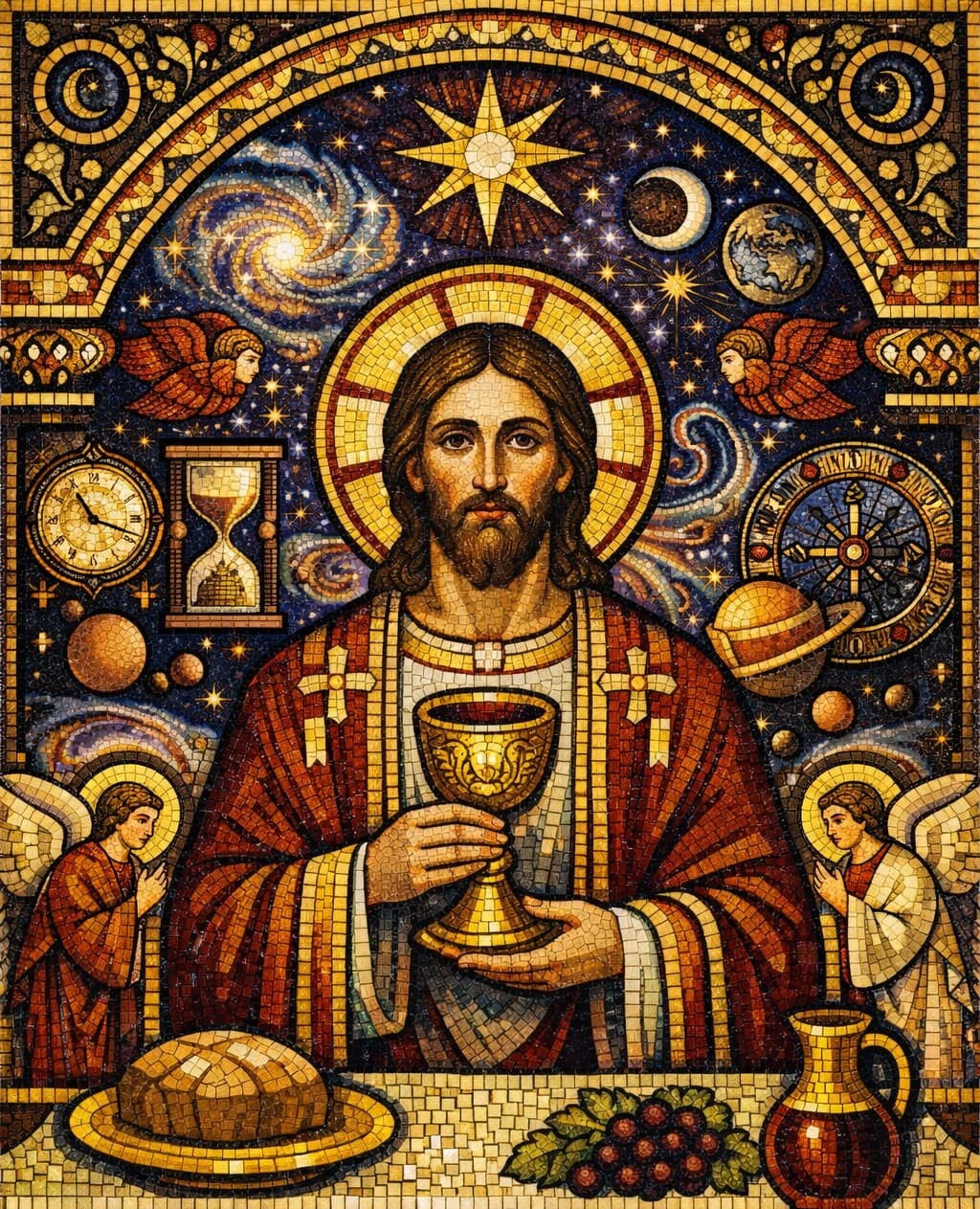
Heaven Touching Earth: The Mystery of the Eucharist
I. Introduction
Writing about the Eucharist is long overdue for me. For the past eight months I have been on a journey, and when I started it I had no idea where it would take me. It began, strangely enough, deep in research regarding the nature of gravity - a rabbit hole that, through a chain of connections I never anticipated, led me to investigating miracles associated with the historical churches, namely Catholicism and Orthodoxy.
One of those miracles stopped me cold. In Lanciano, Italy, around the 8th century, a monk doubting the real presence of Christ in the Eucharist witnessed the host transform visibly into flesh and the wine into blood. What makes this account remarkable is not merely the historical claim, but that the flesh and blood have been scientifically analyzed in the modern era - confirmed to be real human cardiac tissue and blood of type AB, showing no signs of preservation despite over a thousand years of existence. I had no framework for this. I was not looking for it, and I could not easily dismiss it.
Growing up non-denominational, communion was always a symbolic practice - a remembrance of Christ's last supper, observed infrequently and without much theological weight. I had never been given a reason to think otherwise. But the miracle of Lanciano forced a question I could not unask: if something that significant was being claimed, and apparently verified, what exactly did the Church believe was happening at that table?
That question is what set everything in motion. I have now fully come to believe that the Eucharist is not a symbol but a true participation in Christ's body and blood, attested by Scripture, the Fathers, and unbroken Tradition.
II. What Christ Actually Said
There is no better place to start than with the actual words of Christ, in one of the most graphic chapters in the Gospels, John chapter 6. To keep this article from being absurdly long, I ask that you read John 6, starting at verse 25 to the end and return here after doing so.
I can reasonably expect that at this point you have either gone and read it, or are already familiar with this chapter, so we can agree as a starting point with this statement; the plain text makes no room for judgment about what Christ means, he is explicit and honest about it, and this becomes even more profound when the Greek meanings are preserved. Let me give you a more accurate translation, because Jesus does not say "eat" every time - he actually shifts to a different Greek term:
"Truly, truly, I say to you, unless you gnaw the flesh of the Son of Man and drink his blood, you have no life in you. Whoever gnaws my flesh and drinks my blood has eternal life, and I will raise him up on the last day. For my flesh is true food, and my blood is true drink. Whoever gnaws my flesh and drinks my blood abides in me, and I in him."
- John 6:53–56
The word rendered here as "gnaw" is the Greek trōgein (τρώγειν) - a deliberately visceral, physical term meaning to chew or gnaw, the kind of word used to describe an animal eating. This is concrete language, not poetic. Earlier in the same passage, Jesus uses the more general Greek word phagein (φαγεῖν), the ordinary term for eating. But at precisely the moment his audience recoils in offense and confusion, he does not retreat - but rather he intensifies. He reaches for a more graphic word, not a softer one. If ever there was a moment to clarify that he was speaking metaphorically, this was it.
Yet he does not.
Christ said many things with his silence, this not being the least of them. We know this because Jesus is perfectly capable of clarifying himself when he intends a figure of speech. Consider John chapter 4, when he tells the Samaritan woman that he can give her "living water" so that she will "never thirst again." She takes him literally, confused about how he would draw this water from a well. Jesus immediately explains himself - the living water he offers is spiritual, welling up to eternal life. The misunderstanding is corrected on the spot.
In John 6, the same pattern of misunderstanding occurs. His listeners are confused and offended - "How can this man give us his flesh to eat?" - and many of his own disciples declare the teaching too hard to accept and walk away. Christ watches them leave. He turns to the twelve and asks if they too wish to go. What he does not do is call them back to explain that they misunderstood, that he was speaking symbolically, that of course he did not mean it literally.
The contrast between John 4 and John 6 is very important because it shows us that Jesus corrects literal misunderstandings when they are literal misunderstandings. Here, he does not correct - because there is nothing to correct.
It would be dishonest to say that the plain text, when read simply for what it says, is inconclusive. To approach this scholarly, though, we must acknowledge that words go beyond plain text - let us observe how the apostles viewed this teaching, and their disciples after them, to determine whether they believed this to be metaphorical.
III. What the Earliest Christians Believed
If the apostles understood Christ's words in John 6 as metaphorical, we would expect to find that understanding reflected in their writing and in the writing of those they personally discipled. What we find instead is the opposite - and it is consistent enough to constitute a verdict.
Begin with Paul, writing to the Corinthians no later than A.D. 55, within a single generation of the Last Supper:
"Whoever, therefore, eats the bread or drinks the cup of the Lord in an unworthy manner will be guilty of the body and blood of the Lord... For anyone who eats and drinks without discerning the body eats and drinks judgment on himself. That is why many of you are weak and ill, and some have died."
- 1 Corinthians 11:27–30
Sit with that for a moment. Paul says that receiving the Eucharist unworthily brings physical illness and even death upon the recipient. He says the unworthy communicant becomes guilty of the body and blood of the Lord. This is not the language one uses about a symbol or a memorial. You cannot be guilty of mishandling a metaphor. You cannot become sick from irreverence toward a piece of bread that represents something absent. Paul's warning only carries any weight at all if what is being received is genuinely, objectively holy - if Christ is actually present in what is consumed. The logic is inescapable: Paul believed exactly what Christ said in John 6.
Move forward roughly fifty years. Ignatius of Antioch, bishop, martyr, and a direct disciple of the apostle John himself, writes a series of letters around A.D. 107 while being transported to Rome for execution. In his letter to the Smyrnaeans, he describes a group of heretics - likely early Docetists, who denied the physical reality of Christ's body - and identifies their rejection of the Eucharist as the defining mark of their error:
"They abstain from the Eucharist and from prayer, because they do not confess that the Eucharist is the flesh of our Savior Jesus Christ, the flesh which suffered for our sins and which the Father, in His goodness, raised up again."
Notice also that he connects the Eucharistic flesh directly to the flesh that suffered and rose. The Greek word he is drawing on here is sarx (σάρξ) - the most concrete, physical word for flesh available in Greek. It does not mean spirit, symbol, or abstraction. It means bodily, corporeal flesh. This same word appears in one of the most foundational verses in all of Christian theology - John 1:14: "And the Word became flesh" - ὁ λόγος σὰρξ ἐγένετο (ho logos sarx egeneto). John does not say the Word became a symbol of flesh, or that the Word appeared as flesh, but that He became σάρξ - actually, physically, really. When Ignatius uses this same word to describe what the Eucharist is, he is not reaching for a new concept. He is drawing on the same incarnational language that John himself established. The flesh present in the Eucharist, for Ignatius, is the same flesh that was born of Mary, that was nailed to the cross, and that rose from the tomb. To receive the Eucharist is to receive, in some real and mysterious sense, the very thing that the Incarnation made possible. For Ignatius - and for Orthodox theology after him - the Eucharist is not a separate doctrine from the Incarnation. It is its continuation.
Justin Martyr, writing his First Apology around A.D. 155 to a pagan Roman emperor, describes Christian worship in detail - including the Eucharist. He writes with no hesitation:
"We do not receive these things as common bread or common drink; but just as Jesus Christ our Savior, being incarnate by the word of God, took flesh and blood for our salvation, so too we have been taught that the food over which thanks has been given by the prayer of the word which is from Him - is the flesh and blood of that incarnate Jesus."
Justin is writing to someone with no reason to believe any of this - a pagan emperor skeptical of Christianity. He is not softening the teaching for an outside audience. He states plainly and without qualification what Christians believe happens at their table. And he frames it, again, in incarnational terms: just as the Word became flesh, so the bread becomes His flesh. The pattern is consistent.
Irenaeus of Lyons, writing around A.D. 180, adds a dimension that becomes important later. He argues that the reality of the Eucharist is actually proof against Gnostic contempt for the physical world. If the material elements of bread and wine truly become the body and blood of Christ, then matter itself is capable of bearing the divine - and the created world cannot be dismissed as corrupt or evil. For Irenaeus, the Eucharist is not only about receiving Christ but about the sanctification of physical reality itself.
What is striking about these witnesses is not merely what they say, but when and where they say it. Paul writes from Ephesus. Ignatius writes from Antioch and dies in Rome. Justin writes in Rome. Irenaeus writes in Gaul. These are different men, in different cities, writing in different decades, with no opportunity to coordinate their theology. And yet on this point they speak with one voice.
This isn't some medieval invention or later corruption imposed on an originally simpler faith. The belief that Christ is truly present in the Eucharist is the oldest documented Christian belief about the Eucharist. There is no early Christian writer who interprets John 6 symbolically, no early community for whom communion was merely a memorial. That reading does not appear in the historical record until the sixteenth century - fifteen hundred years after Christ, and fifteen hundred years after Paul warned that receiving the Eucharist unworthily could kill you.
The burden of proof, at this point, does not rest with those who hold the ancient view.
What we have examined thus far amounts to a cumulative case that is difficult to dismiss. The "memorial only" reading requires reading against the plain text of John 6 - and bringing in the surrounding scriptural context only makes the literal understanding more concrete, not less. Paul's warning in 1 Corinthians 11 that unworthy reception brings illness and death becomes completely incoherent if the elements are purely symbolic - a warning without an object is not a warning at all. And the patristic witness seals it: there is no early Christian writer who reads John 6 symbolically, no early community for whom the Eucharist was merely a memorial act. That interpretation has no ancient roots. It appears for the first time fifteen hundred years after the Last Supper, in the sixteenth century, and it does not arrive through careful exegesis of the text.
Having established what the Eucharist is not, we are now faced with a harder and more humbling question: what exactly is it? Here is where I must be honest about something that distinguishes the Orthodox approach from nearly every other theological tradition. Orthodoxy does not offer a precise philosophical definition of what happens to the bread and wine. It does not propose a mechanism. It does not systematize the mystery into a formula and call the formula the thing itself. Where Rome developed the language of transubstantiation - an attempt to explain the transformation using Aristotelian metaphysical categories of substance and accident - Orthodoxy has always held that the Eucharist is real, that Christ is truly present, and that what lies beyond that affirmation belongs to God alone.
This is the only honest response to an encounter with the divine.
IV. The Orthodox Understanding Specifically
To understand what Orthodoxy believes about the Eucharist, you must first understand what Orthodoxy believes about salvation itself - because in the Orthodox tradition, these two things cannot be separated.
Western Christianity has historically framed salvation primarily in legal terms. Man sinned, a debt was incurred, justice demanded payment, and Christ paid it. Orthodoxy regards this as incomplete - a courtroom metaphor stretched beyond what it was designed to hold. The Orthodox understanding of salvation is better captured by a single Greek word: theosis (θέωσις), meaning deification or divinization. The goal of the Christian life is not merely to be forgiven, but to be transformed - to participate in the divine nature itself, to become, as Peter writes, "partakers of the divine nature" (2 Peter 1:4). Salvation is not transactional, it is communal.
This is why the Eucharist sits at the absolute center of Orthodox life. If the goal of Christianity is genuine union with God, then the Eucharist is not one practice among many - it is the primary means by which that union is accomplished and sustained. When the Orthodox Christian receives the body and blood of Christ, he is not performing a ritual of remembrance. He is being joined to God. Ignatius of Antioch called the Eucharist "the medicine of immortality" - and he meant it with full seriousness.
This understanding shapes everything about how the Orthodox Church worships. The Divine Liturgy is not designed to be a helpful gathering or an emotionally engaging service. It is designed to be heaven on earth. The architecture, iconography, incense, chanting, and prayers are not aesthetic preferences but rather deliberate participation in the worship that Revelation describes as occurring eternally before the throne of God. The Eucharist is the culmination of that worship, the moment when heaven and earth are most fully joined.
It follows that the Eucharist cannot be approached casually - which is why Orthodox practice surrounds it with serious preparation. This same reasoning explains closed communion. To those unfamiliar with it, the practice can appear exclusionary. It is worth understanding what it actually means. The Orthodox Church does not withhold communion from non-Orthodox out of contempt. It withholds it out of seriousness about what communion is. To receive the Eucharist is to declare that you share the faith of the Church, that you are in unity with her, that you accept her teachings. For the eucharist to be given flippantly would be to treat without reverence the body and blood of Christ, and could even be deadly to those out of communion with the Church, as we read in Paul's letters from above.
Finally, the Eucharist is never individual. Paul writes in 1 Corinthians 10:17:
"Because there is one bread, we who are many are one body, for we all partake of the one bread."
The Eucharist unites the believer not only to Christ but to every member of His body - the faithful in that parish, the faithful across the world, and every saint who has received from that same table throughout all of Christian history. To receive the Eucharist is to be placed within something far larger than yourself. It is the ultimate act of belonging.
V. Is the Eucharist a Re-Sacrifice?
One of the most common objections raised against the real presence - particularly from Protestant readers - is that a true offering of Christ's body and blood implies a repeated sacrifice. If Christ is truly present on the altar, the argument goes, then He is being sacrificed again and again at every Liturgy, in contradiction to Hebrews 10:10:
"We have been sanctified through the offering of the body of Jesus Christ once for all."
The mistake in this reasoning is a subtle but fundamental one - it assumes that the Eucharist takes place entirely within created time, and therefore that each celebration is a separate event added to a sequence. But the Orthodox understanding of the Eucharist is precisely that it does not take place within created time in that way. God is not bound by the timeline of human history. For Him there is no before and after, no sequence of moments accumulating into a past. There is only the eternal present.
The sacrifice of Christ on Calvary was a singular, unrepeatable event. Orthodoxy does not dispute this. What Orthodoxy affirms is that the Liturgy does not add another sacrifice to that event - it participates in it. The altar is not a place where Christ is sacrificed again. It is a place where the one eternal sacrifice, which exists outside of created time, is made present and offered within time where we are. Every Divine Liturgy celebrated throughout history - from the first century to the last - is not a series of separate offerings but a single participation in the one offering all at once.
The Church is not generating a new sacrifice. She is presenting to God what He has already given - the one body, the one blood, the one death and resurrection that has already accomplished, is accomplishing, and will forever accomplish everything. The faithful gathered at any given Liturgy are not witnessing a repetition but rather are being drawn, across the boundary of created time, into the single eternal moment of Christ's self-offering.
Understood this way, the Eucharist is not a contradiction of Hebrews 10 but its fulfillment. Christ died once for all - and it is precisely because that sacrifice is eternal and all-sufficient that every Christian from every age can truly participate in it. The Orthodox farmer in fourth century Antioch, the martyr receiving communion in a Roman catacomb, and the believer standing at the chalice this coming Sunday are not attending different events. They are all present at the same one.
VI. Conclusion
The Eucharist is not a peripheral ritual, a symbolic gesture, or a footnote to the real business of Christian life. It is the center. It is the point at which heaven touches earth, at which the human being is most fully joined to God, at which the Church becomes most fully herself. Everything examined in this article - the words of Christ, the witness of the apostles, the testimony of the Fathers, the Orthodox understanding of salvation itself - converges on this single act. To marginalize the Eucharist is to push aside the literal offering of Christ's body and to make his death on the cross a peripheral part of the faith.
There is a moment in the Gospel of Mark, in chapter 10, that has stayed with me. James and John come to Christ asking to sit at His right and left hand in His glory - the seats of highest honor. Christ does not rebuke their ambition. Instead He asks them a quiet and devastating question:
"Can you drink the cup that I drink?"
They answer quickly, confidently - yes, we can. And Christ confirms that they will indeed drink it.
To understand what that cup is, you have to follow it backward. In the garden of Gethsemane, the night before His crucifixion, Christ falls on His face and prays: "Father, if it is possible, let this cup pass from me." The cup He is asking to be spared from is death itself - not merely physical death, but the full weight of human mortality, sin, and separation from God, taken into Himself on behalf of everyone who has ever lived. This is the cup He could not set down. This is the cup He drank.
And this is the cup He handed to James and John.
Both of them drank it. James was beheaded by Herod - a swift and literal martyrdom, his blood shed in direct imitation of his Lord. John lived to extreme old age, outlasting everyone, dying not by the sword but under the slow weight of time - a different kind of death, no less real, the daily dying that Paul describes when he writes "I die every day." In the two brothers we have the archetype of every Christian who will ever live. Some are called to die suddenly and violently for the faith. Most are called to die slowly, quietly, in the ordinary suffering of a human life surrendered to God. The cup looks different for each of them. It is the same cup.
To ask for closeness to Christ, to ask to share in His glory, is to be handed a chalice. The answer to James and John's request was not a throne - it was communion. And it was offered to them at a cost they did not yet understand.
That is what the Eucharist is. It is the answer to the deepest human longing - to be close to God, to share in His life, to belong to something that death cannot end. And it is offered freely, at enormous cost, to anyone willing to receive it seriously.